Jamawar textiles emerged from a long history of exchange across Persia and South Asia, shaped by trade, migration, and courtly patronage. First circulating through Persianate networks, these densely patterned textiles travelled into the Indian subcontinent, where they were absorbed into local systems of making and dress. By the eighteenth and nineteenth centuries, Kashmir had become the most important centre for jamawar production.
Jamawars are distinguished by their intricate all-over patterning, dominated by arabesque vines, stylised floral forms, and botehs. These motifs trace their origins to Persian design traditions of the fifteenth century and entered South Asia through imperial movement and patronage, particularly during the Mughal period. As these visual languages travelled, they were transformed by regional tastes and techniques. Persian aesthetics remained present, but they were reworked through Kashmiri material knowledge and expertise.
The production of jamawar relied on pashm, the fine underfleece of Changthangi goats raised in the high Himalayan plateau. Harvested through hand-combing, the fibers were spun into exceptionally fine yarn and woven using the kani technique, a double-interlocking twill tapestry weave. In this method, coloured yarns are woven directly into the structure of the textile rather than embroidered or brocaded onto a surface. The result is a fabric that is both structurally strong and remarkably lightweight, despite the density and complexity of its design.
Jamawar weaving was a collaborative process. Craftspeople worked in independent workshops, often over several years, to complete a single length. The labour-intensive nature of the kani weave meant that jamawars were never mass-produced objects. Even as mechanically woven imitations later appeared, handwoven jamawars retained a distinct material presence rooted in time, skill, and accumulated practice.
Forms and Uses
Jamawar was not a single object but a versatile textile form, adapted to different modes of dress and use. In Persia, it appeared as garments such as the choga (an open coat), patka (sash), and dastar (turban). When adopted in South Asia, jamawar continued to function as clothing associated with rank and wealth, particularly within Mughal courts, while also evolving into shawls that carried equivalent social and ceremonial weight.
As a garment material, jamawar lengths were often assembled into robes that combined Persian design sensibilities with South Asian tailoring. Floral motifs—tulips, irises, lilies, carnations, and pomegranates—appear repeatedly, reflecting a shared Persian and Mughal fascination with gardens and cultivated nature. Many jamawars were woven in Kashmir and then assembled into garments elsewhere, including in Persia, underscoring the textile’s transregional life.
As yardage, jamawar lengths were woven with features such as pallus (borders) that helped define garment openings or edges. Signatures, often woven or embroidered into the fabric, appear on some lengths, indicating systems of trade, authorship, or workshop identity. These inscriptions appear in Indic or Indo-Iranian scripts, as well as Arabic or Urdu, pointing to the movement of jamawars through multilingual commercial networks.
Jamawar as Shawl: Matan and Memory
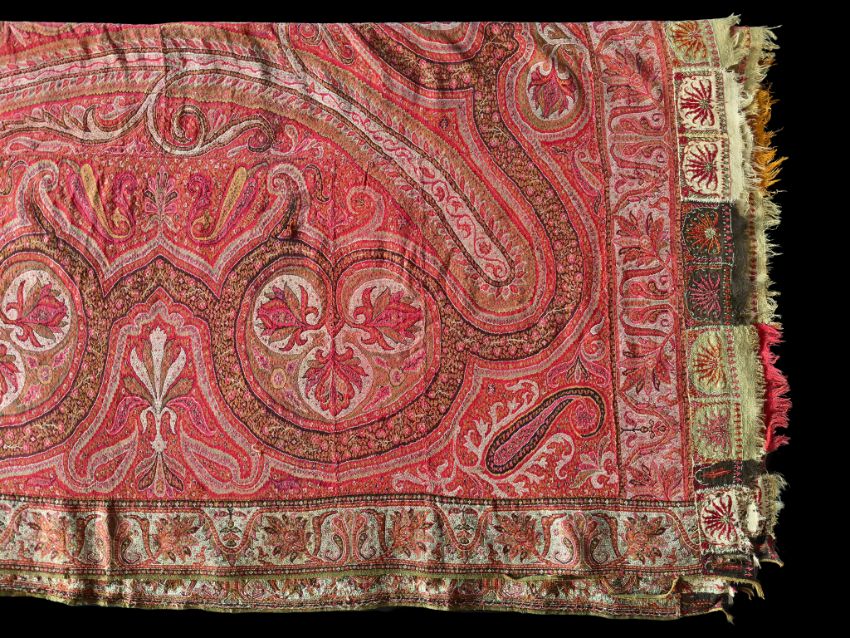
Kashmiri Jamawar Shawl,19th century, Pashm (goat hair), woven in the kani technique
One of the most distinctive adaptations of jamawar was its use as the matan, or central field, of a shawl. Unlike garments, which often display varied motifs across their surface, shawl matans could feature repeated patterns across undyed or lightly coloured grounds. This approach drew on the visual density associated with jamawar while reconfiguring it for draped wear.
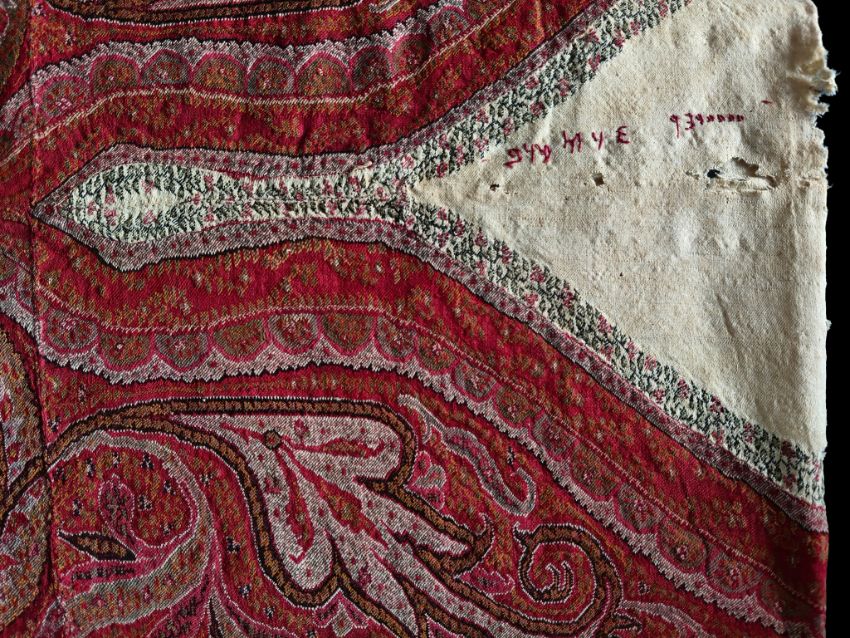
Reverse of Jamawar Shawl
Detail of woven structure consistent with kani tapestry weaving.
In some examples, the distinction between yardage, garment, and finished shawl is deliberately blurred. Textiles woven with repeated motifs across the entire field may have been intended either as material for tailoring or as the finished object itself. Such ambiguity reflects the flexibility of jamawar production and the adaptability of its designs.
By the late nineteenth and early twentieth centuries, jamawar shawls sometimes incorporated finishing techniques associated with European markets, such as fringe tabs, while retaining Kashmiri elements like sozni embroidery and double-faced construction. These hybrid forms document a period in which jamawar design circulated between Kashmir, the Greater Punjab region, and Europe, without severing its connection to earlier South Asian traditions.
Continuity and Change
Although jamawars continue to be handwoven in Kashmir today, the practice survives among a small number of craftspeople. Mechanically produced facsimiles dominate the market due to lower costs, but handwoven jamawars remain distinct in structure, weight, and visual complexity.
Across centuries, jamawar textiles have carried material memory: of landscapes, imperial movement, skilled labour, and shifting modes of dress. Whether worn as robes, assembled into garments, or draped as shawls, they record how design traditions travelled, settled, and evolved across regions. Preserved within elite households and passed down through generations, jamawars remain documents of cultural exchange expressed through cloth.
This essay takes as its point of reference a nineteenth-century jamawar shawl from the Estate of Sir Mangaldas Nathubhai, offered in Prinseps’ Decorative Sale (January 2026).

