My Sculpture Garden Grows
To be precise my garden is currently two flower pots but as any other Oval Maidan (Mumbai) or Central Park (NY) facing resident would say – the entire oval (park) is my garden!
Read More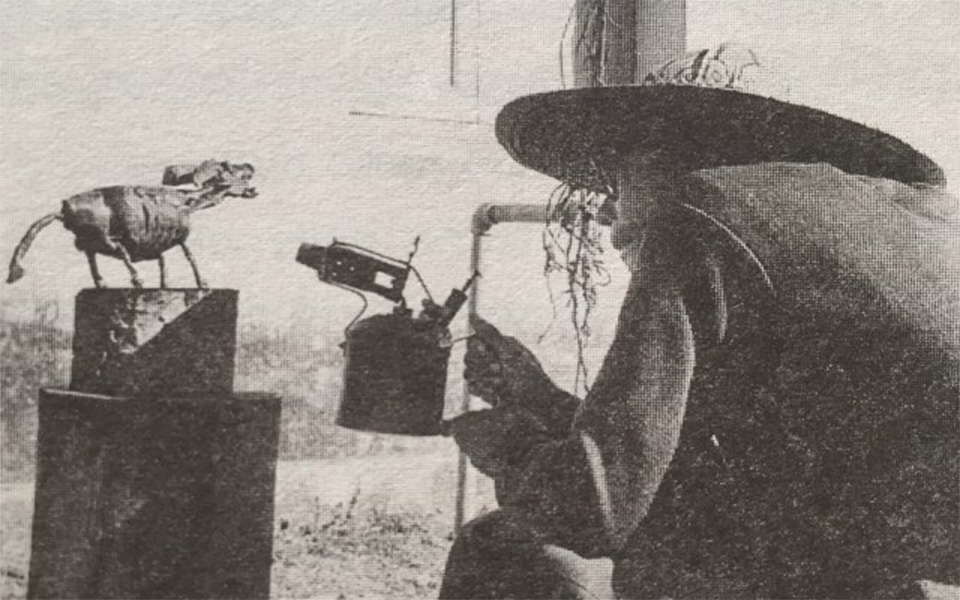
To be precise my garden is currently two flower pots but as any other Oval Maidan (Mumbai) or Central Park (NY) facing resident would say – the entire oval (park) is my garden!
Read More
The first of the transcripts documenting the formation of the 'Calcutta Group' , a letter dated March 1942 written by Subho Tagore in Calcutta to Rathin Maitra in Pabna foreseeing a vision in creating something to illuminate the nation's art!
Read More
From the humble lanes of Beliatore to the grand pages of Indian art history, Jamini Roy's life was a journey of artistic awakening. His artistic journey, deeply rooted in Bengal's folk traditions, reflects a bold departure from the Western academic styles. The following timeline translated from the Bengali text Jamini Roy: Jibonpanji, written by Debasish Mukhopadhyay, presents a chronological account of his life, education, and major achievements.
Read More.jpg)
Xu Beihong, Jamini Roy, and a Possible Crossroad of Indian & Chinese Modernism The title of this note requires some explanation. Xu Beihong (Ju Peon) is widely regarded as the father of Chinese Modernism, while Jamini Roy is known as the father of Indian Modernism. [12,21] The works under discussion come from the estate of Jamini Roy, yet are believed to be by Xu Beihong, hence the framing as a “Tale of Two Fathers.”
Read More.jpg)
Shanu Lahiri was Nirode Majumdar's sister and reminisces here about the formation of the Calcutta group in her book ' Smritir Collage' . The quotes and translations are from the same.
Read More
This academic exploration serves as an archive, offering a testament to the sought-after portraiture skills artist Atul Bose. Through a collection of newspaper cuttings, we delve into the intersection of artistry and history, with each article representing a chapter in the narrative of this renowned portrait artist. These cuttings, meticulously preserved, provide valuable insights into the recognition and praise garnered by Atul Bose's creations over time, as they secured their esteemed place within museums and government institutes.
Read More.jpg)
...have hurt my ears severely. In entire India, it is only in Bengal, that Sanskrit pronunciation is such non-Aryan. Mutilation of Sanskrit in such a manner, I have not seen in any other state. Especially convolution of utter-able mantras is to be considered a blunder. Since it has hurt me, I had to say this.
Read More
Within the sphere of art historical exploration, the oeuvre of Surendranath Ganguly emerges as a subject of intriguing contemplation. A notable practitioner born in 1885, Ganguly's artistic journey found its genesis at the Government School of Art Calcutta, under the guidance of luminaries such as EB Havell and the visionary Abanindranath Tagore. Aligned with the artistic philosophy of Tagore, Ganguly, alongside Nandalal Bose, played an instrumental role in the revival of Indian artistic traditions that had been relegated to obscurity.
Read More
Various organizations have been working for the advancement of art. From the pages of history, we learn that the first such organization in Calcutta was founded in 1830, named the Brush Club. At that time Prince Dwarakanath Tagore was at the forefront among several Indian and British entrepreneurs. Its lifespan was short. Over time, many organizations were established one after another, but with short lifespans. The Indian Society of Oriental Art founded in 1907, is the only one that remains active to this day. In recent time, one of the active institutions of this kind is Prinseps.
Read More
After many days, today I am present in front of you in this shrine (mandir). I have come with a lot of hesitation. I am aware that due to prolonged absence our entire organization has become weak. For whatever reason it may be, your minds are no longer ready to accept all the functions, activities, and rites of the Ashrama. There is no point denying this. For this, not only are you to be held responsible but we are equally responsible.
Read More

Install this application on your home screen for quick and easy access
 then 'Add to Home Screen'