Santiniketan


Leathercraft at Santiniketan

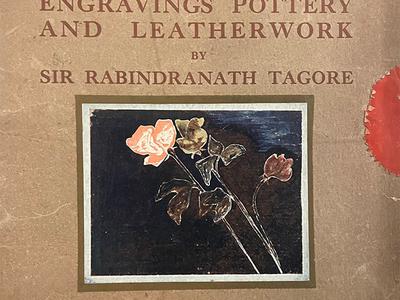
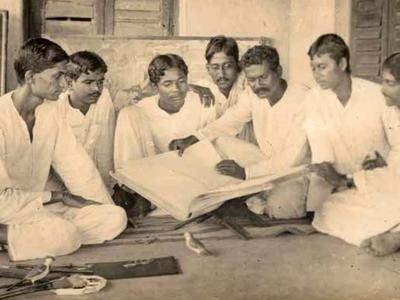
Leatherwork in Santiniketan originated from a broader movement to revive the traditional crafts of rural Bengal and reintroduce skilled occupations to village life. In the early decades of the twentieth century, Rabindranath Tagore turned his attention to the villages surrounding Santiniketan and began to organise a programme of rural reconstruction that placed work, skill, and livelihood at the centre of education. In the early 1920s, at Sriniketan, he established a rural reconstruction centre where agriculture and village industries were developed as regular institutional activity. Craft entered this programme as part of daily labour. Weaving, carpentry, pottery, dyeing, and leatherwork were taught alongside cultivation and rural service, and workshops became working spaces where students and village artisans learned trades. Speaking about the purpose of this effort, Rabindranath expressed the principle that guided the work: "The drama of national self-expression could not be real if rural India were banished."Within this programme, leatherwork was developed through the initiative of Rathindranath Tagore. In 1928, during his stay in England, he began studying leatherwork and developed a lasting interest in the craft. After returning to Santiniketan later that year, he introduced leatherwork to students and continued to practise it within the training system at Sriniketan. In 1930, after formal vocational instruction in Europe with Pratima Devi, he established a regular leather workshop at Silpa Sadan. Ink and Embossing on Leather by RathindranathTagore From 1932, the workshop produced a growing range of leather goods—handbags, book covers, portfolios, trays, and domestic objects—made from vegetable-tanned goat and sheepskin and decorated through embossing, stencil work, and batik techniques. These objects soon appeared in exhibitions and institutional displays, carrying the name Santiniketan and establishing a recognizable tradition of leather craftsmanship rooted in the revival of rural craft. 

Read More
Leathercraft at Santiniketan

Santiniketan in Correspondence

At Santiniketan, correspondence played an essential role in artistic life. Letters, postcards, and small drawings circulated steadily between students, teachers, administrators, and friends, creating a working network through which ideas, images, and observations moved across distances. These exchanges were not incidental. They were closely aligned with Rabindranath Tagore’s educational vision, in which learning extended beyond the classroom into daily life, travel, and conversation, and in which artistic practice was embedded within lived experience rather than confined to formal instruction.

Read More
Santiniketan in Correspondence


Sunayani Devi

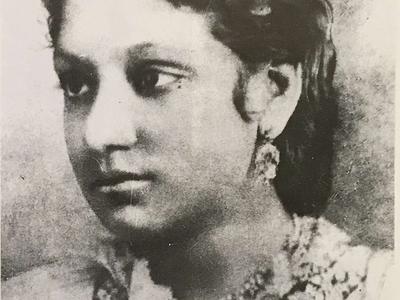
The first Indian woman painter to gain public recognition Sunayani Devi (সুনয়নী দেবী) was born in Calcutta, to the Tagore family of ingenious writers and painters.Often considered among the first women painters in India, she grew up amidst the cultural ferment that was the Bengal Renaissance. She was brought up in the traditional and secluded women's quarters. She recalls her fascination with the devotional pictures in her aunt's room as a child. At that time, " it was unknown and unheard of for women to do anything."

Read More
Sunayani Devi

Rabindranath Tagore's speeches: A speech from the Mandir

After many days, today I am present in front of you in this shrine (mandir). I have come with a lot of hesitation. I am aware that due to prolonged absence our entire organization has become weak. For whatever reason it may be, your minds are no longer ready to accept all the functions, activities, and rites of the Ashrama. There is no point denying this. For this, not only are you to be held responsible but we are equally responsible.

Read More
Rabindranath Tagore's speeches: A speech from the Mandir

Any questions?