This is a research note on early post-independence modernism (1951-1952) and steps towards abstraction, with a specific focus on Bhanu Athaiya.
Artworks - Prayer and Lady In Repose
We take images from the 1953 exhibition catalogue of the progressives to serve as a comparison point.
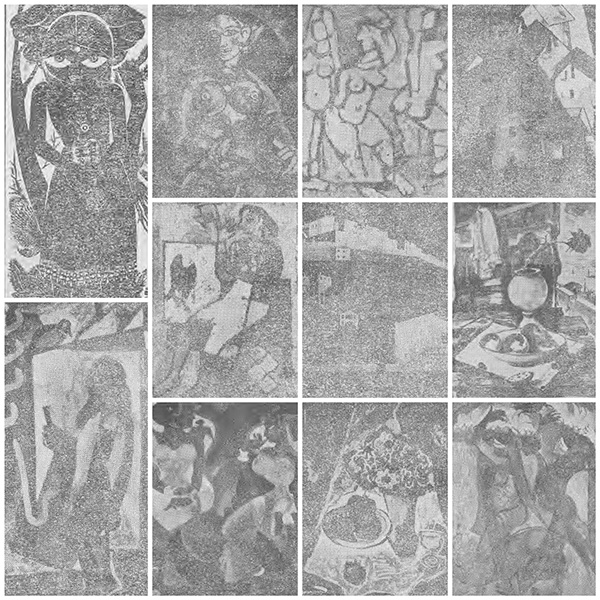
There were two works by Bhanu in this exhibition catalogue - Prayer (not pictured in catalogue) and Banana Sellers (bottom corner).
The following is a study of three artworks - all from 1952 and surely created in chronological order as below.
1. A figurative study (Bhanu Athaiya, Prayer, Mixed Media on paper)
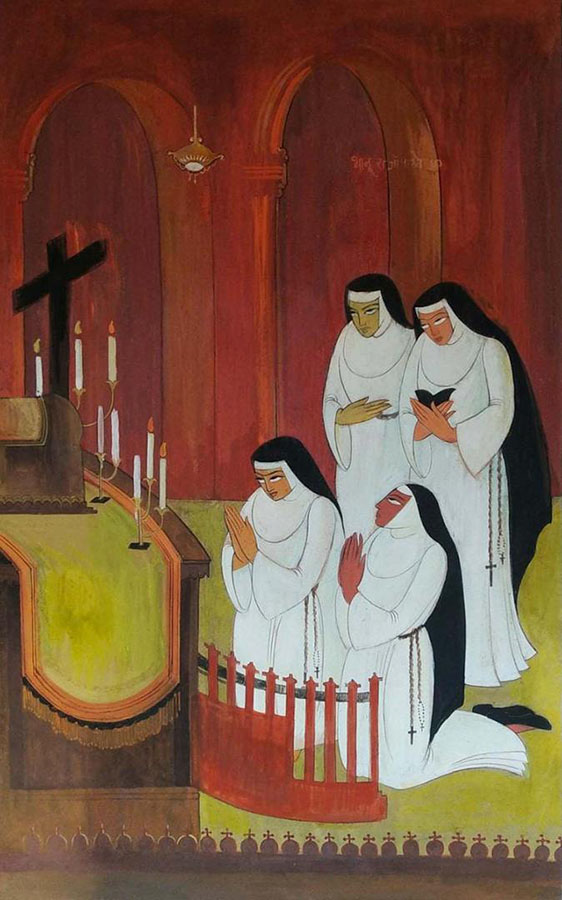 ©Prinseps
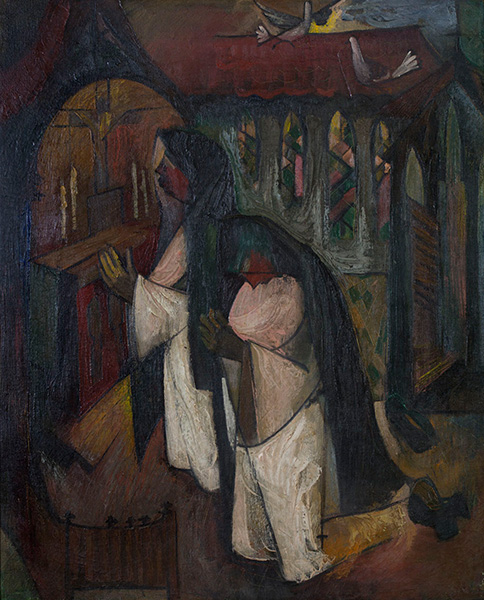
2. Step towards abstraction (Bhanu Athaiya, Prayer, 1952, Oil on Canvas)
In this work by Bhanu titled Prayers, exhibited in the Progressives exhibition in 1953 we see the breaking of the form into triangles and shapes, which can be described as an early attempt in Cubism. The colours in the artwork are described as ‘convent colors’ (stained glass inspired) and the classic Bhanu ‘pinkish white’.
What is important to note is that, compared with the other works in the 1953 exhibition catalog, this (Prayers) appears to be a step forward in the language of modernism.
 ©Prinseps
The following is observed / noted :
- Cross hatches(referred to as the Lead Cam on the stained glass windows) on the top right.
- The combinations of myriad colours. This must have been the stained glass ambiance at the Mazgaon convent
- Penti-menti in the positioning of the legs and the feet (closest to the bottom edge) with some of the corrections likely covered in black. Penti-Menti essentially implies that the artist is experimenting on the canvas; therefore, this is the first of its kind/series and not a subsequent copy etc.
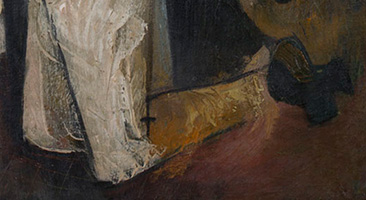
The section under the knees has been blackened out, likely after a change. The confusion that is still apparent in the orientation of the feet.
- You can also see some hazy cross-hatches at the bottom - tiles ? light ?
“The muted and deep hues during the normal days at the convent juxtaposed with the pageantry at Christman Eve Mass in the Byculla church inspired me to paint the nuns as a tribute to them.
…
Surprisingly when the painting was exhibited at a french get-together with PAG, nobody saw it as something drawn from personal experience but insisted that I had done a copy of some foreign work.” [ Notes as dictated by Bhanu Athaiya to her daughter Radhika Gupta ]
3. Further Into Abstraction - Lady In Repose (Oil on Canvas, Signed Bhanu 52)
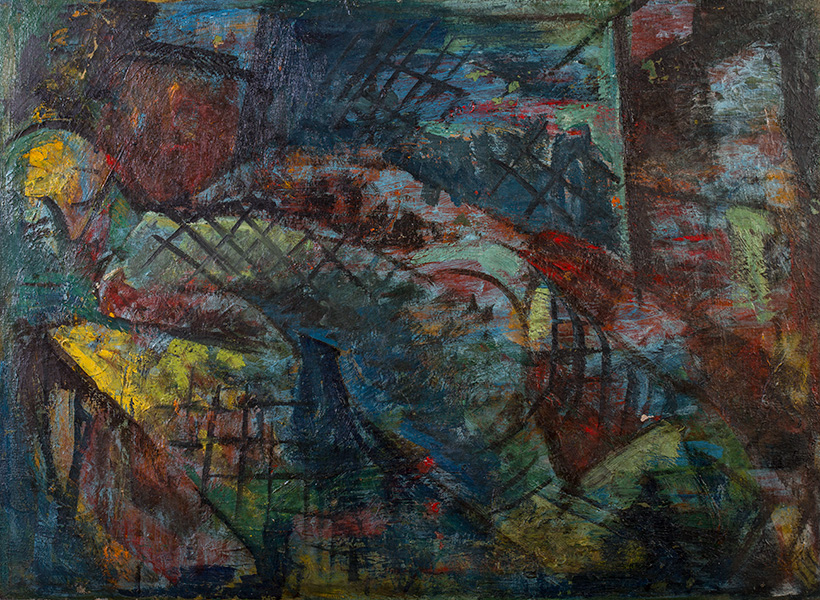 ©Prinseps
Penti Menti
Lets take a look at the execution of the hands and legs. Penti Menti essentially indicated the first of the series, an early work !
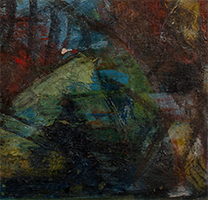
The changes are possibly clearer in black and white. The legs have changed orientation and the changed areas are covered in black.
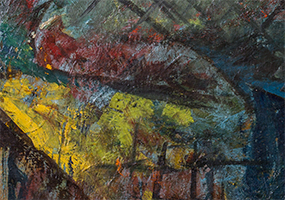
The location of the hand has been adjusted and the experimental areas covered in black.
Cross Hatches
Here, the cross-hatches have taken over the entire canvas, from being restricted to the window. The metal pieces that hold together the stained glass in a criss-cross pattern are referred to as “lead cams”. These criss-crossed lead cams have been abstracted away from the window to become “an ambiance” across the room
Colours
The same vivid colours
“Both the Lying Lady and the Nuns were painted as part of my study at J.J. The play of light through the stained glass windows and glass arches above doors added.” [ Notes as dictated by Bhanu Athaiya to her daughter Radhika Gupta ]
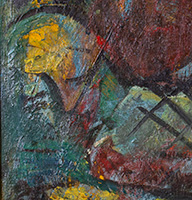
Note the orientation of the face. If you stare at it long enough, it feels as if it is giving you a stare back! Focus on the distinctive nose for clarity.
.png)
The yellow claw feet.
The Lady In Repose is.a superlative example that extends the language of modernism
In Summary
Referring to Ranjit Hoskote - “Art is a continuum. Its not as if the Three Magi came out of the sky and modernism happened”. The two canvases are early experiments in abstraction (1952!). They set the tone and expectations for the decades ahead.
Team Prinseps
N.B. Another version of the Lady In Repose was created - this time by Gaitonde in 1954. Similar composition - window in the right, woman on a platform facing up, similar composition in the legs, Similar facial composition - note the nose. An almost identical blackening out of a section between the left hand and torso, a similar play of light, etc.
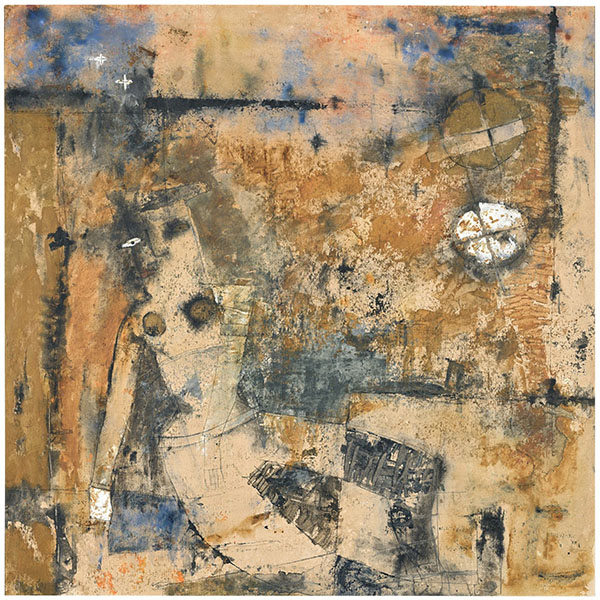
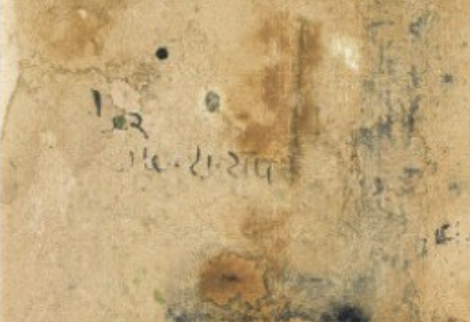
The signature on this work is a bit confusing/unclear.
1952 seems to be an interesting year. A movement towards abstraction and away from the figurative.
Note the composition in quite a few of these works is similar - figure on a mat/platform in the lower left quadrant. A light source/windown in the upper right quadrant. There appears to be another work with the same composition, possibly an earlier precursor.
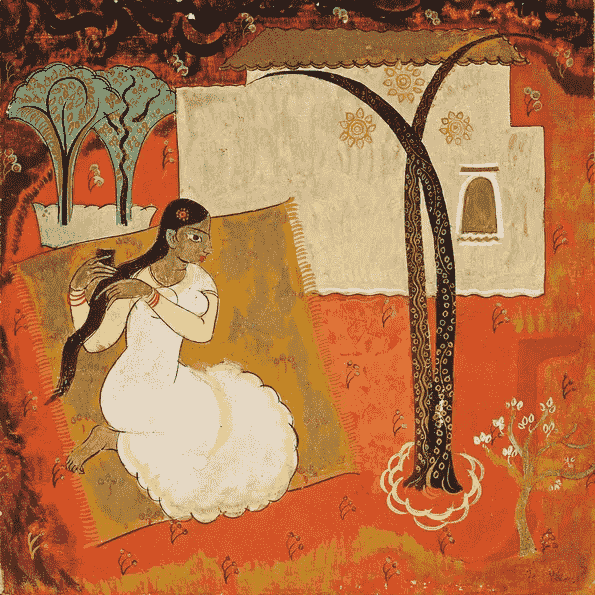
Gaitonde? 1952
It is interesting to see how art changed in 1952 from figurative studies towards abstraction as seen in works by Bhanu Athaiya. 1952 is also the year that we see Paul Klee-inspired artworks by Gaitonde. Certainly a pivotal year in Indian art.

