When the Orientalist William Jones wrote his hymn to Saraswati in the late eighteenth century, he described the goddess as the “patroness of fine arts, especially of Musick and Rhetorick. (archaic)” Reflecting on the poetic tradition surrounding her, Jones remarked that it evokes the Ragmala—the “Necklace of Musical Modes,” which he called “the most beautiful union of Painting with poetical Mythology and the genuine theory of Musick.” [1] His observation captures something essential about Saraswati’s place in Indian culture: she belongs at once to music, language, and the visual arts.
Across sculpture, illustrated manuscripts, and later devotional imagery, Saraswati is often depicted seated with the veena resting across her lap, sometimes holding a manuscript or rosary, the swan beside her. By the nineteenth century, this image of the goddess circulated widely through paintings and printed oleographs—most famously those derived from the works of Raja Ravi Varma—appearing in homes, schools, and temples across India.
Yet the figure of Saraswati is rooted in a much older tradition of Vedic verse. In the hymns of the Rigveda, she appears as both river and deity. “Ambitame naditame devitame Saraswati”—often translated as “best of mothers, best of rivers, best of goddesses” (Rigveda 2.41.16) [2] In these early hymns she is praised as a powerful river within the ritual poetry of the Vedic tradition. Saraswati is also closely associated with speech (Vāc) within the Vedic imagination, a connection that later reinforced her role as the patron deity of knowledge and learning.
When artists in the early twentieth century turned to Saraswati, they encountered not only a mythological figure but also a long visual inheritance. The paintings of Sunayani Devi in Calcutta and Baburao Painter (Baburao Mestry was popularly referred to as Baburao Painter) in Kolhapur show how this inheritance could be reinterpreted within very different artistic worlds.
Baburao Painter: Saraswati beside the River
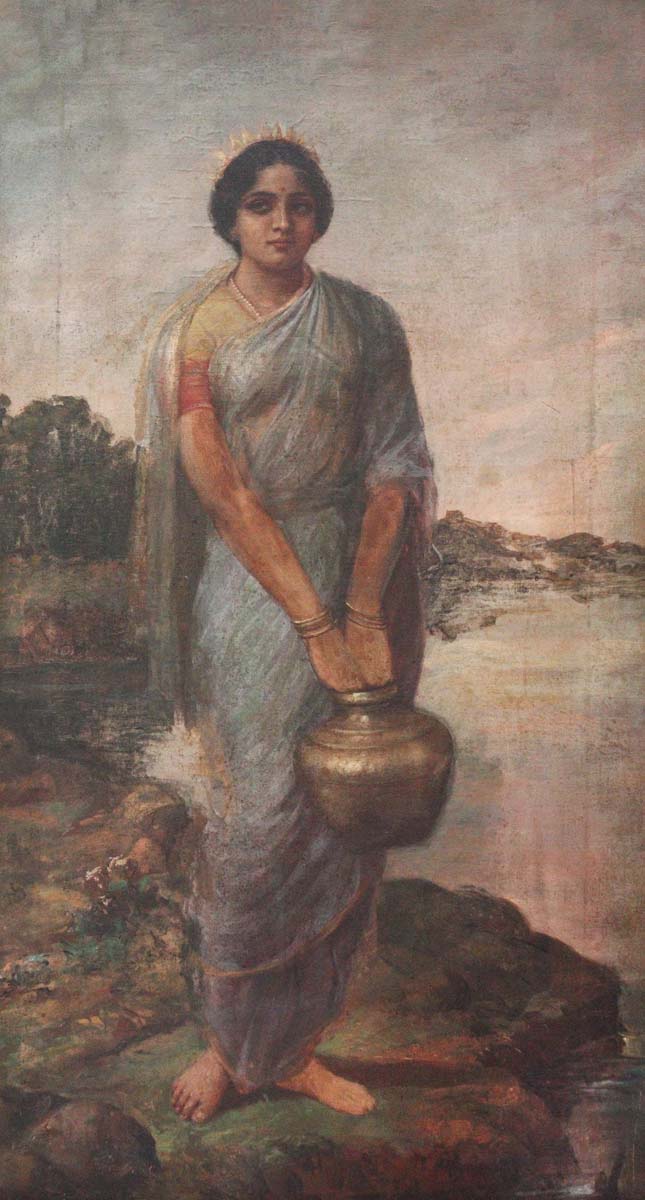
Baburao Painter, Nadi Kachi Madhur Smriti, circa 1930
Oil on canvas, Bhanu Athaiya Estate
Baburao Painter worked in Kolhapur at a time when the city had become an important centre of theatre, photography, and early cinema. A versatile artist, he moved between painting, sculpture, stage design, and filmmaking. In 1918 he founded the Maharashtra Film Company, an institution that played a significant role in the development of Indian cinema and trained future filmmakers such as V. Shantaram. He was apparently close to and is photographed next to Annasaheb Rajopadhye, another film-maker and Bhanu's father.
Baburao Painter’s studio reflected this expansive approach to visual production. Designed to accommodate unusually large canvases, the building incorporated mechanisms that allowed paintings to be raised and lowered between floors so that artists could work on images at monumental scale. His experience painting theatrical scenery and working with photographic imagery shaped the spatial composition of many of his works.
In Saraswati, Goddess of Wisdom, also titled 'Nadi Kachi Madhur Smriti' (I Daydream Next to the River), the goddess appears standing barefoot on a rocky riverbank, holding a kalash. A small diadem above her head marks her divine identity, yet the image departs from the more familiar iconographic forms in which Saraswati is shown with the veena and swan. Instead, Painter situates the figure within a natural landscape, with the river extending behind her.
The presence of the river carries particular resonance. In the hymns of the Rigveda, Saraswati is praised both as a river and as a deity within the sacred geography of the Vedic world. By placing the figure beside flowing water, Painter’s composition recalls this earlier association between the goddess and the river that bears her name.
Another version appears in Ratnakar (Marathi Magazine), June 1926, likely preserved in one of the Kolhapur government museums.
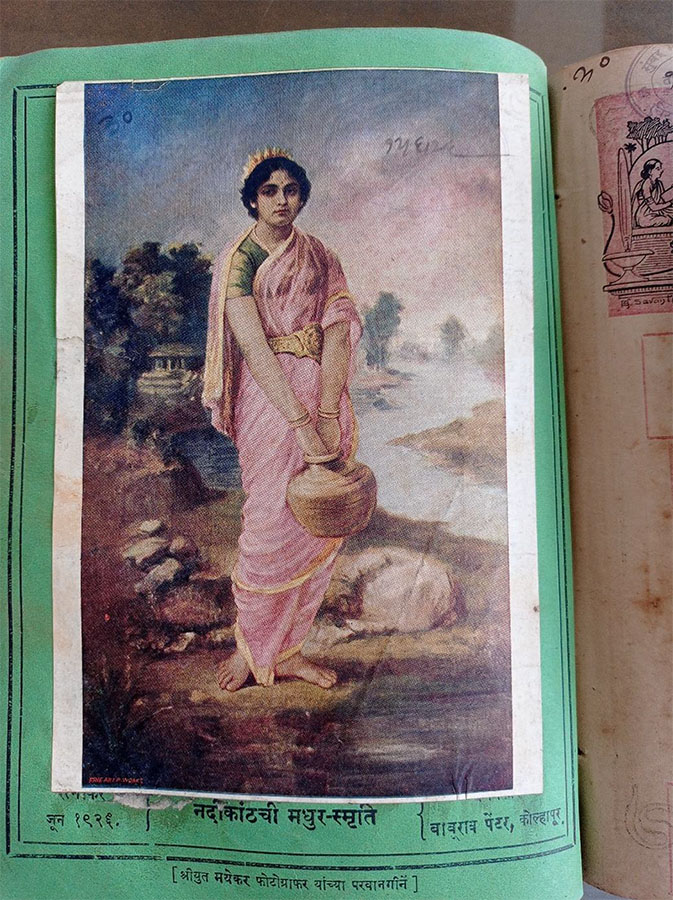
Reproduced in Ratnakar (Marathi Magazine), June 1926; a Saraswati image likely held in a Kolhapur government museum.
This painting is significant not only for its rarity—most of Baburao Painter’s works remain in Kolhapur institutions—but also for its intimate connection to Bhanu Athaiya, who credited early exposure to artists like Painter for shaping her creative path. The work remained for decades within her extended family, and a 2014 photo shows Bhanu and her daughter Radhika Gupta with the painting in the background.
.jpg)
Bhanu Rajopadhye Athaiya with daughter Radhika Gupta in her studio with Painter's Nadi Kachi Madhur Smriti in the background
Sunayani Devi: Saraswati from the Inner World
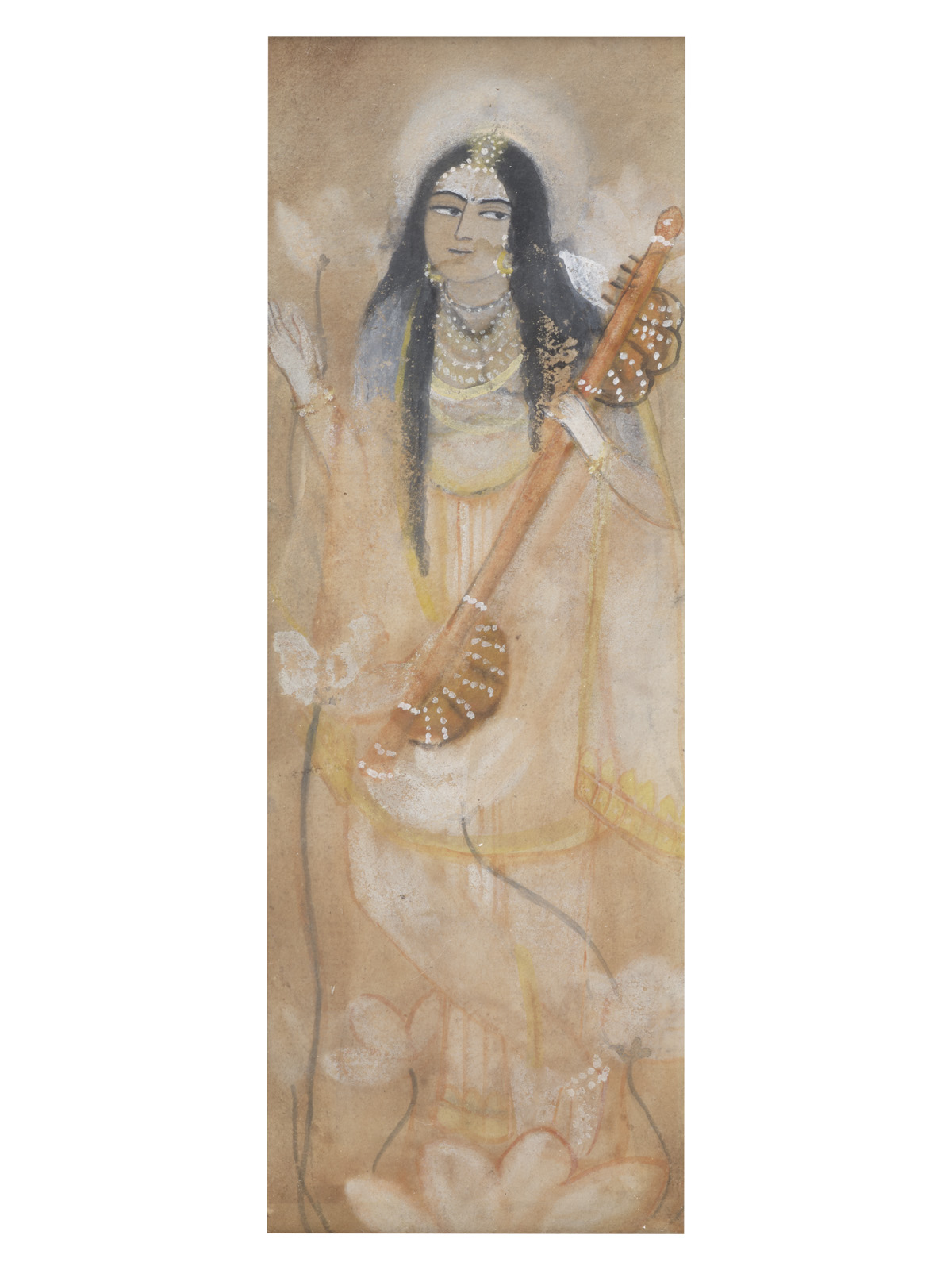
Sunayani Devi, Untitled (Saraswati), Watercolour / tempera on paper
Born into the Tagore household in Calcutta, Sunayani Devi grew up within the cultural milieu of the Bengal Renaissance. Her brothers, Abanindranath Tagore and Gaganendranath Tagore, were already influential figures in the development of modern Indian art. Sunayani’s own artistic practice, however, developed within the domestic spaces of the household.
Unlike many artists of her time, she received no formal academic training. She began painting in her thirties, working within the rhythms of family life. Family accounts describe her seated on a taktaposh, painting while supervising the daily activities of the household. The images she produced drew upon visual traditions familiar within the Tagore home, including devotional prints, illustrated magazines such as Probasi and Modern Review, and the folk painting traditions of Bengal, particularly pata painting.
Sunayani once described the origin of many of her works with striking simplicity: “Most of my paintings I have seen in dreams. After seeing them I have then put them down.” [3]
This quality can be seen in her representations of Saraswati. The face is rounded and simply modeled, while the elongated, half-closed eyes form the most striking feature of the figure. In many of her paintings the eyes occupy a central place in the composition. The expressive strength of this feature did not go unnoticed by her contemporaries. Her brother, the painter Gaganendranath Tagore, once remarked: “No one can draw eyes or eyebrows like Sunayani.” [4]
The significance of such eyes has been discussed in relation to Indian pictorial conventions. As G. Venkatachalam observes:
“The half-closed, elongated eyes which give an introspective look… are used for portraying divine beings; the fish-shaped eyes with long eyebrows for women and royalties; the eyes of a deer in springtime for lovers; the almond-shaped eyes for men of pleasure; and the lotus-petal eyes for gods and girls… Every conventional type in Indian art has its deeper significance and purpose; and Sunayani Devi… has coined her own type for her human and divine subjects.” [5]
In her Saraswati, the goddess holds the veena yet appears without elaborate ornament. The figure emerges from softly layered washes of colour, a technique associated with the wash method developed in the Tagore circle.
Sunayani’s engagement with folk visual traditions unfolded within a broader moment in early twentieth-century Bengal when artists began to rediscover regional painting practices. The work of Jamini Roy, who later turned toward Kalighat and rural Bengali painting traditions, reflects a similar interest in the expressive languages of folk art. [6]
The works of Sunayani Devi and Baburao Painter belong to this continuum. Each artist encountered Saraswati within a different artistic world. In Sunayani Devi’s work, the goddess appears through the simplified forms and inward gaze characteristic of her paintings, while in Baburao Painter’s image, she stands beside the river itself, recalling the older association between Saraswati and the waters praised in the hymns of the Rigveda.
From the Archives of Baburao Painter
A studio photograph from Baburao Painter’s circle offers a glimpse into the artistic milieu of Kolhapur in the early twentieth century.
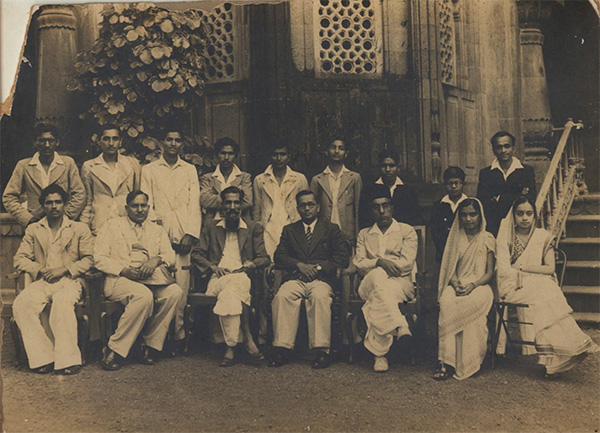
Studio photograph, Kolhapur, early twentieth century. Front row: Baburao Painter (left of centre, with beard) and Annasaheb Rajopadhye (right of centre, wearing a cap; Bhanu Athaiya’s father).
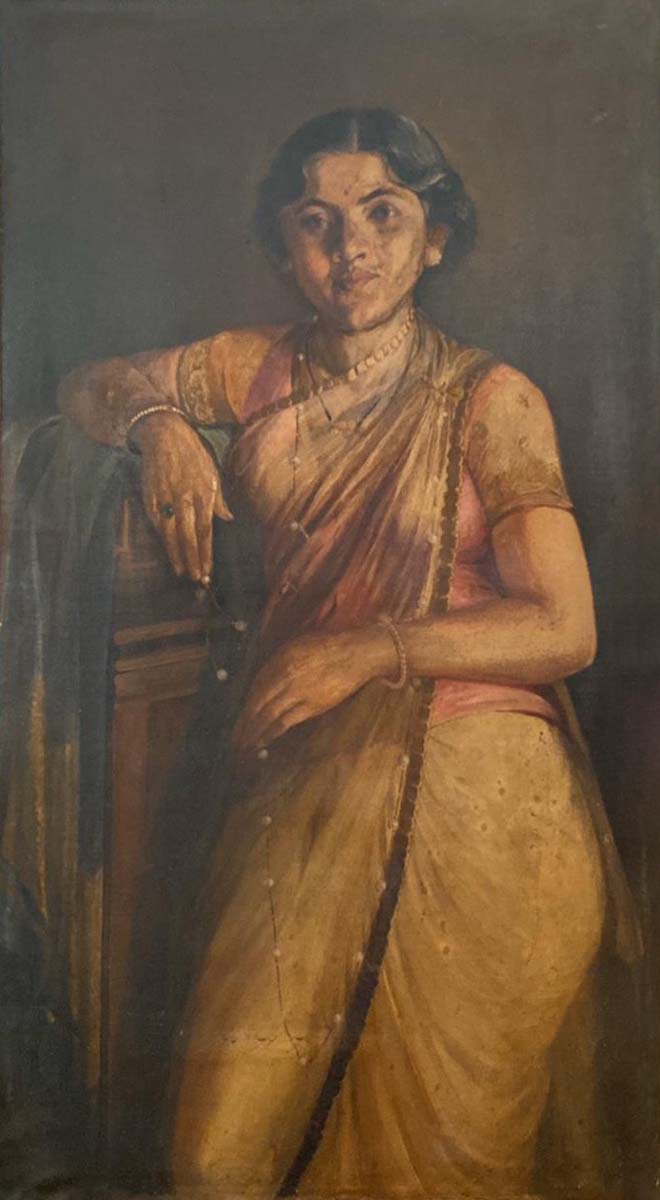
Baburao Painter, Portrait of Shantabai, Oil on canvas, circa 1930
Within this milieu, a portrait of Shantabai, wife of Annasaheb Rajopadhye, brings into view a more intimate, domestic presence. In personal notes, Bhanu Athaiya recalls her mother as a formative influence who nurtured her early engagement with the arts.
References
[1] William Jones, A Hymn to Sereswaty, The Asiatick Miscellany, Volume 1 (Calcutta: Daniel Stuart, 1785), 179-187
[2] Jamison, Stephanie W., and Joel P. Brereton. The Rigveda: The Earliest Religious Poetry of India. Oxford University Press, 2014.
[3] Amina Kar, Sunayani Devi - A primitive of the Bengal School. Lalit Kala Contemporary. 1966.
[4] ibid
[5] Venkatachalam, G. Sunayani Devi. Contemporary Indian Painters, G. Venkatachalam, Nalanda Publications, Bombay
[6] Saurabh Dube, Subjects of Modernity, Manchester University Press. Republished with permission by AFRICAN SUN MEDIA, 2017.
[7] Partha Mitter, The Triumph of Modernism, 2017.
[8] Shukla Sawant, The Trace Beneath: The Photographic Residue in the Early Twentieth-century Paintings of the “Bombay School”, 2017.

