Rathindranath Tagore


Leathercraft at Santiniketan

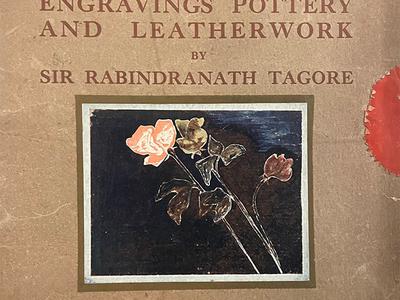
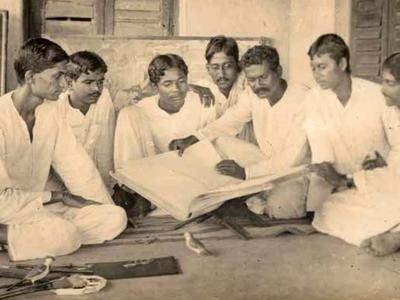
Leatherwork in Santiniketan originated from a broader movement to revive the traditional crafts of rural Bengal and reintroduce skilled occupations to village life. In the early decades of the twentieth century, Rabindranath Tagore turned his attention to the villages surrounding Santiniketan and began to organise a programme of rural reconstruction that placed work, skill, and livelihood at the centre of education. In the early 1920s, at Sriniketan, he established a rural reconstruction centre where agriculture and village industries were developed as regular institutional activity. Craft entered this programme as part of daily labour. Weaving, carpentry, pottery, dyeing, and leatherwork were taught alongside cultivation and rural service, and workshops became working spaces where students and village artisans learned trades. Speaking about the purpose of this effort, Rabindranath expressed the principle that guided the work: "The drama of national self-expression could not be real if rural India were banished."Within this programme, leatherwork was developed through the initiative of Rathindranath Tagore. In 1928, during his stay in England, he began studying leatherwork and developed a lasting interest in the craft. After returning to Santiniketan later that year, he introduced leatherwork to students and continued to practise it within the training system at Sriniketan. In 1930, after formal vocational instruction in Europe with Pratima Devi, he established a regular leather workshop at Silpa Sadan. Ink and Embossing on Leather by RathindranathTagore From 1932, the workshop produced a growing range of leather goods—handbags, book covers, portfolios, trays, and domestic objects—made from vegetable-tanned goat and sheepskin and decorated through embossing, stencil work, and batik techniques. These objects soon appeared in exhibitions and institutional displays, carrying the name Santiniketan and establishing a recognizable tradition of leather craftsmanship rooted in the revival of rural craft. 

Read More
Leathercraft at Santiniketan

Santiniketan in Correspondence

At Santiniketan, correspondence played an essential role in artistic life. Letters, postcards, and small drawings circulated steadily between students, teachers, administrators, and friends, creating a working network through which ideas, images, and observations moved across distances. These exchanges were not incidental. They were closely aligned with Rabindranath Tagore’s educational vision, in which learning extended beyond the classroom into daily life, travel, and conversation, and in which artistic practice was embedded within lived experience rather than confined to formal instruction.

Read More
Santiniketan in Correspondence


Atul Bose and the Art of Portraiture

The art of portraiture seems much more enticing today when we live in a world where ‘portraits’ can be created at the click of a button with a single handheld device. There is something enigmatic about how artists in the past captured personalities with strokes of the brush and immortalized them in portraits. There is something romantic about the notion of portraits themselves, and how a sensitive artist could capture the physical characteristics as well as the psychological aspect of the subject of the portrait. 

Read More
Atul Bose and the Art of Portraiture

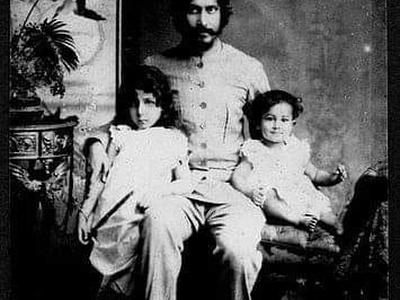
Rathindranath Tagore (1888 - 1961)

Rathindranath was not only one of the first five boys of the Santiniketan Brahmacharyasrama, but he was also one of the reasons for its existence. Rathindranath was the most representative product of Rabindranath’s educational ideal.

Read More
Rathindranath Tagore (1888 - 1961)

Memories of Mitali and my Jethu - Rathindranath Tagore

My earliest memories are swathed in the scent of mountain pines and a constant leitmotif of a rattling train that would carry me back to our home in Dehradun named Mitali on Rajpur Road – my magical El Dorado – where I spent my childhood with my mother, Meera ma, my maternal grandmother, Lal dida, and my Jethu and foster father, Rathindranath (Tagore).

Read More
Memories of  Mitali and my Jethu - Rathindranath Tagore

Any questions?