A sweeping battlefield unfolds across the canvas, the vast sky painted a dull orange. At the centre stands General Sir Charles Napier on an elevated ground, surrounded by the Queen’s 22nd Regiment. The terrain breaks into dry riverbeds and trenches hurling haunting sounds of intense combat. A fraction of the troops continue to press forward through the uneven landscape while another navigates a distant plain.
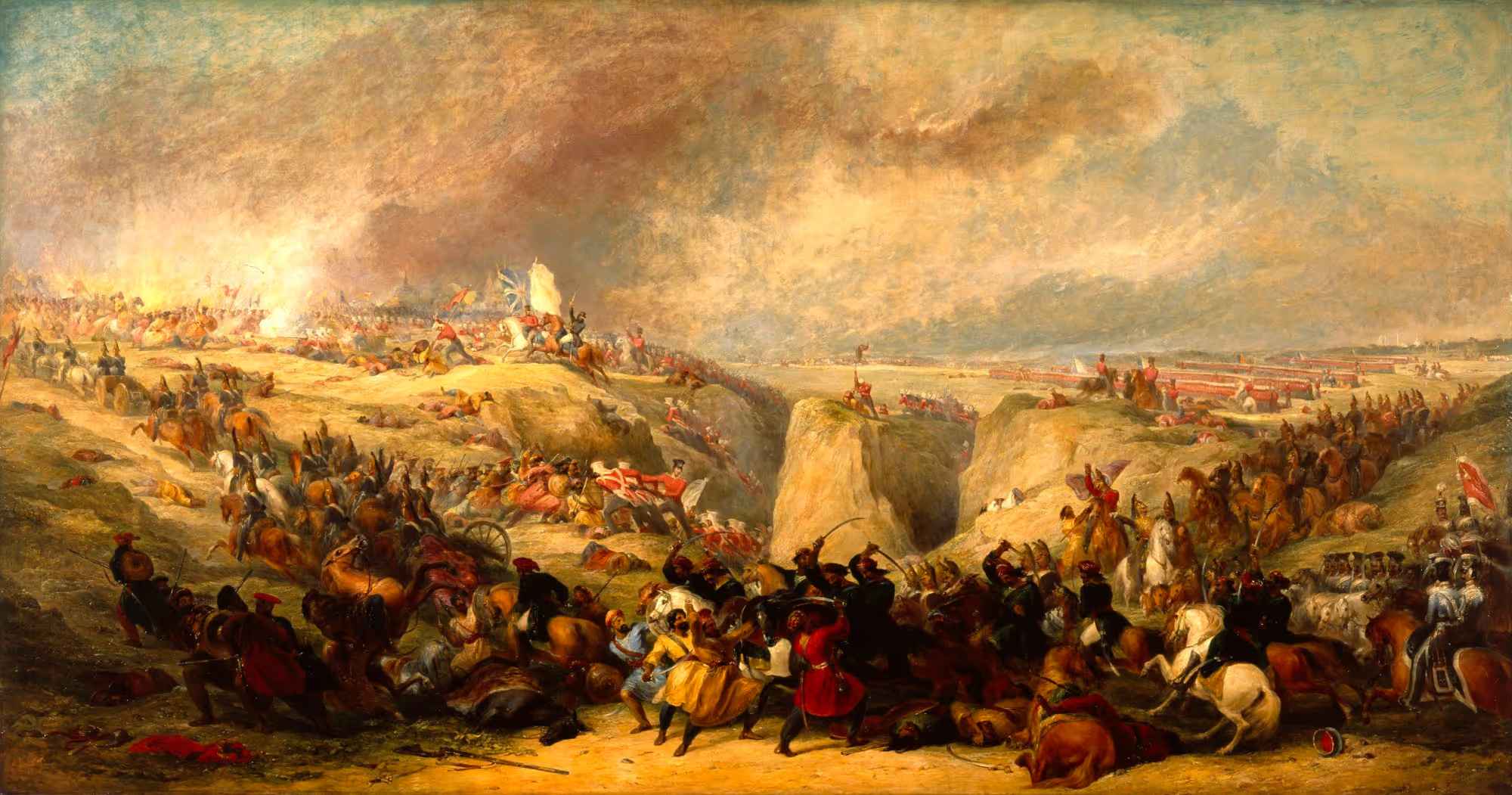
Battle of Hyderabad by George Jones RA at the Royal Academy of Arts, London.
To one side, artillery is manoeuvred across a dry river to reinforce the attack, as cavalry units occupy the foreground and rear of the artwork. In the distance, Hyderabad rises from the horizon, situating the scene’s geographical context within Sindh (present day Pakistan) in 1843.
“The Battle of Hyderabad”, painted by George Jones RA depicts one of the two major battles fought as part of a military campaign by Britain against the Talpur dynasty to conquer Sindh into British India. A recent discovery of a possible version of the painting invites a closer study of the work. To situate the work within its artistic context, it is useful to turn to the life and career of its maker.
Born in London to a mezzotint engraver named John Jones, George Jones RA was a renowned British painter and a Keeper of the Royal Academy, responsible for the RA Schools. At the tender age of 15, Jones became a student at the Royal Academy in 1801 and exhibited a painting of a biblical scene just two years later.
For the next eight years, he would continue to frequently exhibit his works at the Royal Academy before putting his career as a full-time artist on hiatus to join the Royal Montgomeryshire Militia, a Welsh auxiliary regiment organised for home defense. Jones was also part of the army of occupation in Paris after the Battle of Waterloo. After the war, Jones resumed his art career and created several paintings of military engagements including the Battle of Waterloo, Crimean War and the Scinde campaign paintings.
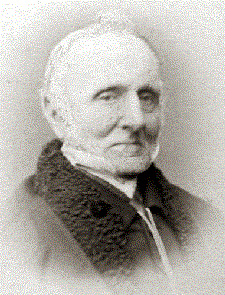
George Jones RA.
George Jones maintained a close association with William Napier, a historian, author and the brother of General Sir Charles Napier, an officer in the British Army who served in the Peninsular War, the War of 1812, and later in India. In 1843, General Sir Charles Napier led the conquest of Sindh and was appointed its first Governor, a position he held until his return to England in October 1847.
Napier was also associated with enforcing British social reform policies in India, including measures against sati, which had been formally enforced in 1829 under Lord William Bentinck, the Governor-General at that time. He was later appointed Commander-in-Chief in India in 1849.
Upon the successful conquest of Sindh, Napier is believed to have dispatched a one word message to his superiors in London. “Peccavi”, the Latin for “I have sinned”, a pun on “I have Sindh”. 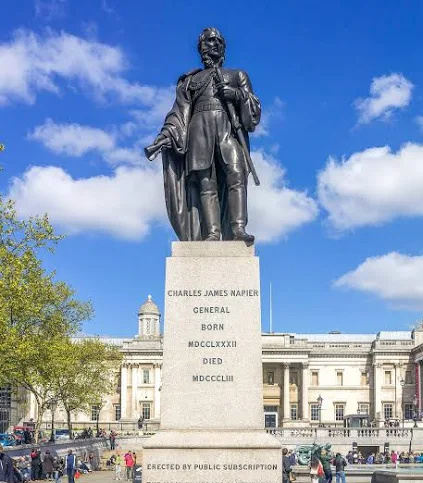
Statue of General Sir Charles James Napier at Trafalgar Square, London.
In the wake of the Scinde victories of 1842–43, William commissioned Jones to produce works that would support his brother’s reputation, amid criticism that the campaigns had been driven by personal ambition. Jones went on to paint several scenes from the battles, including The Battle of Meeanee, The Battle of Trukee, and The Battle of Hyderabad.
Under the supervision of General Sir Charles Napier, George Jones created multiple versions of the painting “The Battle of Hyderabad”, of which one is housed at the Royal Academy of Arts, London and another at the Birmingham Museums Trust collection.
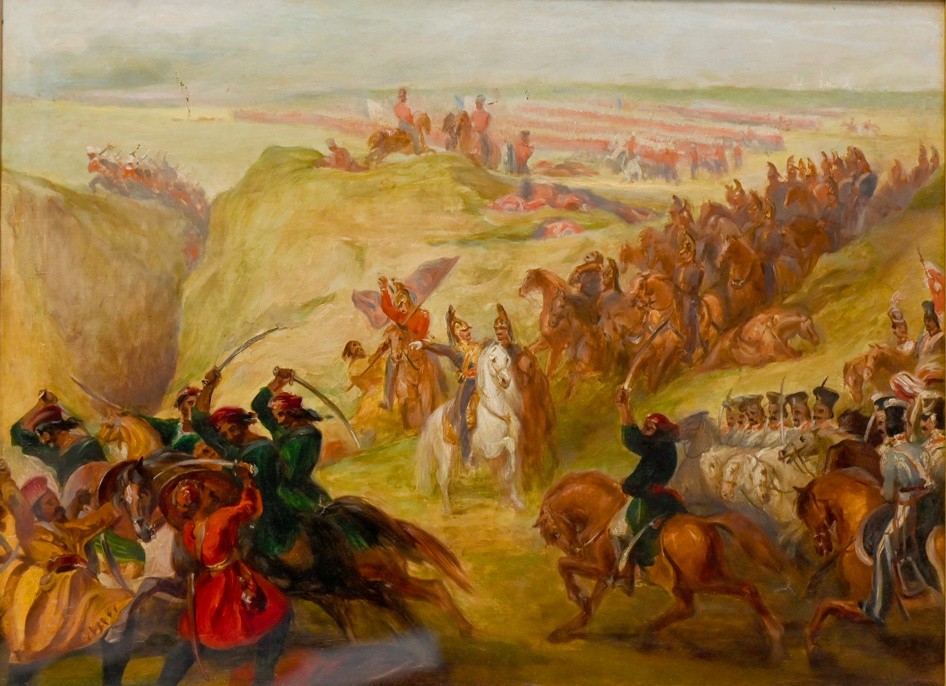
Under Research: The Battle of Hyderabad.
Another version of the painting has recently come to light. Held in a private collection for over 25 years, it was long believed to depict the Battle of Hyderabad, assumed to reference Hyderabad in India. However, closer examination reveals similarities between this work and the version held at the Royal Academy of Arts.
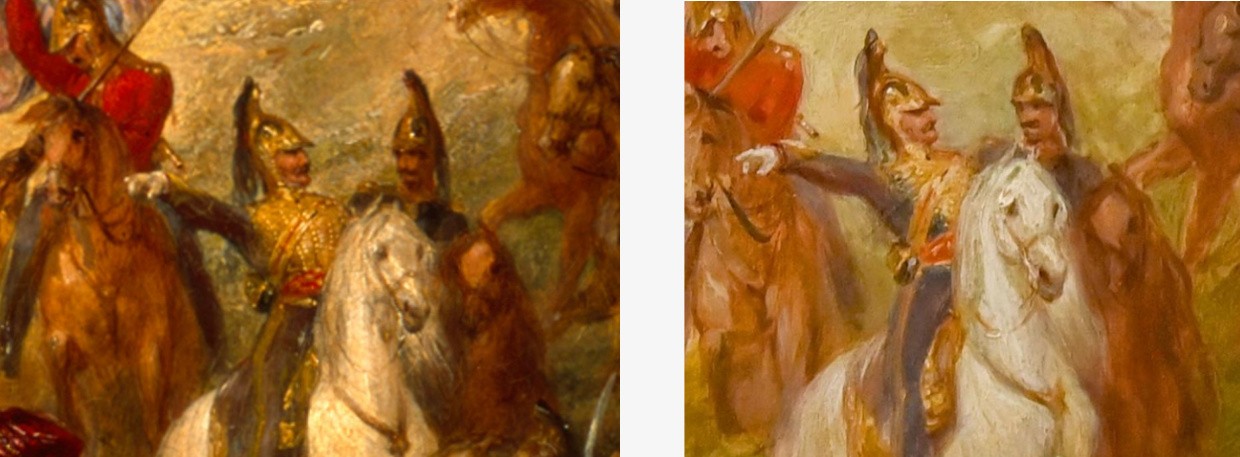
Comparison between General Sir Charles Napier’s depiction in “The Battle of Hyderabad” at Royal Academy and the version under research.
It is evident that details such as the horses, postures and figures are similar, sometimes even identical between the two artworks. However, further research is pending before any attribution to George Jones RA can be made.
References:
- The Battle of Hyderabad, Royal Academy
- Profile of General Sir Charles James Napier, St Pauls Cathedral
- Widow Burning: The Burning Issue of Colonial Britain and India, Utrecht University
- William Francis Patrick Napier, The history of General Sir Charles Napier's conquest of Scinde, 1785-1860.

