In nineteenth-century Bombay, silver occupied a central place in the homes of the city’s leading families. More than tableware, it marked entry into a way of life shaped by inheritance and continuity, giving material form to the old notion of being “born with a silver spoon.”
In such families, whose homes functioned as sites of social exchange and civic obligation, silver returned to the table for formal meals, family ceremonies, and gatherings that brought together kin and guests. The silver service preserved by the family of Sir Mangaldas Nathubhai belongs firmly to this domestic world. His Girgaum house, built in 1855, and later his residence on Malabar Hill were homes in which family life unfolded alongside public responsibility. Meals laid at these tables gathered the extended family, leaders of the Kapole Bania community, and associates drawn from Bombay’s reformist and civic circles. The household calendar was marked through these occasions—births, weddings, and rites of remembrance—set alongside the regular rhythm of formal dining through which domestic, community, and public life converged.
Domestic Ritual and Memory
As Mita Sujan, great-great-granddaughter of Sir Mangaldas Nathubhai, recalls:
The silverware was used extensively over generations—weddings, births, the first feeding of solid food, and the one-year celebration of life on passing. We kept a service for twelve. It was used for a sit-down dinner at my own wedding. The last time it was used was at the one-year ceremony for Ma’s passing. Lots of hopes, dreams, and memories were shared over the gleaming silver.
Sir Mangaldas Nathubhai was a major figure in the city’s reform era, knighted for his contributions to education, women’s education, healthcare, civic improvement, and public institutions. His Girgaum residence and later his Malabar Hill home were active centres of Bombay’s social and civic life. The family silver reflects that history of hospitality, ceremony, and continuity.
Monograms and Lineage
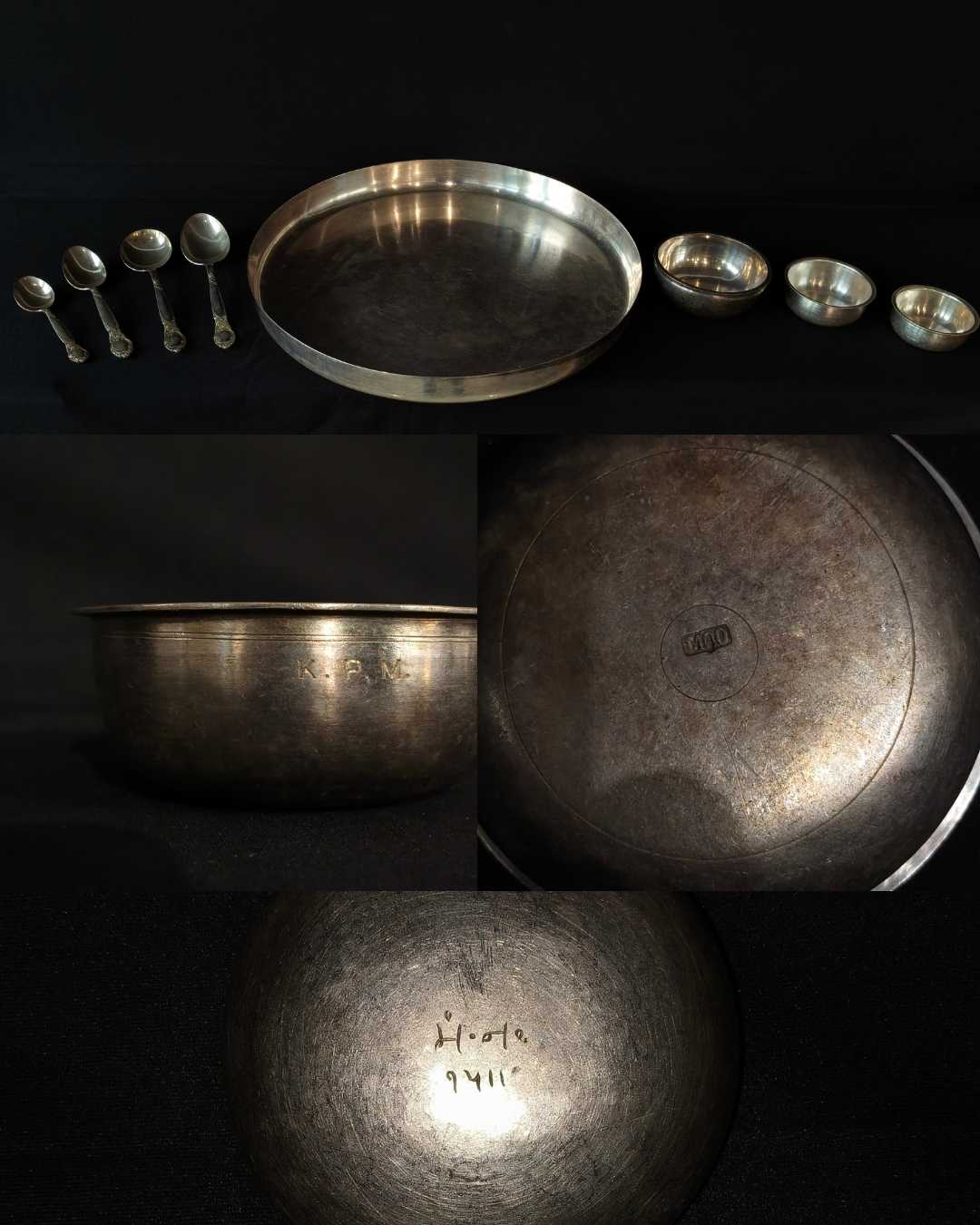
Elements of the Mangaldas Nathubhai family silver service, including plates, bowls, serving spoons, monogrammed surfaces, and the engraved “100” mark denoting solid silver.
Several pieces in the service bear the monogram MN, identifying Sir Mangaldas Nathubhai himself. Others carry KPM, referring to his grandson, Kishoredas Purushottamdas Mangaldas. While some depict inscriptions of names, such as Kamlavati Purushottamdas Mangaldas, Kishoredas's sister, and Kusemben, Kishoredas's wife. Such markings recorded ownership as the silver passed from one generation to the next. Together, they trace the movement of the service through the family’s successive homes, from the Girgaum house to the Malabar Hill residence, and later to the Commonwealth building at Nariman Point following the sale of the Malabar Hill property in 1953. Read as material records, the monograms anchor the silver within both family lineage and the changing geography of Bombay across nearly 150 years.
.jpg)
Stamped maker’s mark in Gujarati reading “Tribhovandas Bhimji Zaveri,” incorporating the “100” purity mark indicating solid silver; visible on the underside of a plate from the Mangaldas Nathubhai family silver service
The presence of a Gujarati maker’s stamp reading Tribhovandas Bhimji Zaveri situates the service within Bombay’s nineteenth-century silversmithing networks, reinforcing both material quality and provenance.
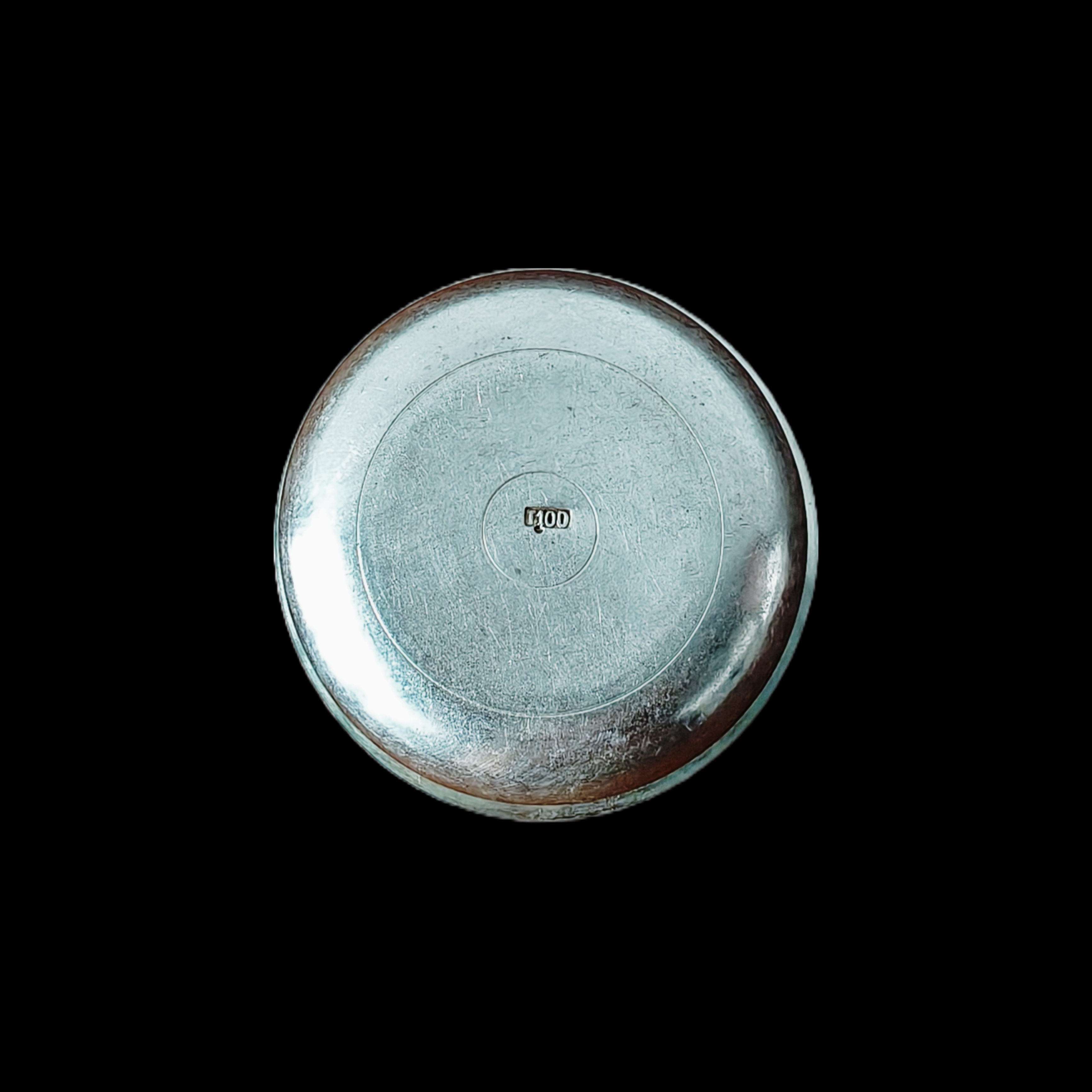
Engraved purity mark reading “100,” indicating solid silver; visible on the underside of a bowl from the Mangaldas family silver service
A Complete Domestic Service
.jpg)
Components of a nineteenth-century domestic silver service, maintained as a functional set for formal dining.
Preserved as a complete domestic service, the silver has remained intact across four generations. Maintained consistently as a service for twelve, it reflects a household accustomed to formal dining and sustained hospitality. Unlike many nineteenth-century silver services that were later divided, melted down, or dispersed, this set continued in use well into the twentieth century, passing through the hands of successive generations.
The service comprises twelve large dinner plates, twelve medium bowls, twenty-four small bowls, four large serving spoons, four medium serving spoons, twelve dinner spoons, and twelve dessert or tea spoons, with a combined weight of 23.8 kilograms. Rarely does a nineteenth-century domestic service of this scale, condition, and documented family history remain together.
Offered now from the estate of Sir Mangaldas Nathubhai, it represents an exceptional survival of Bombay’s domestic and civic heritage.
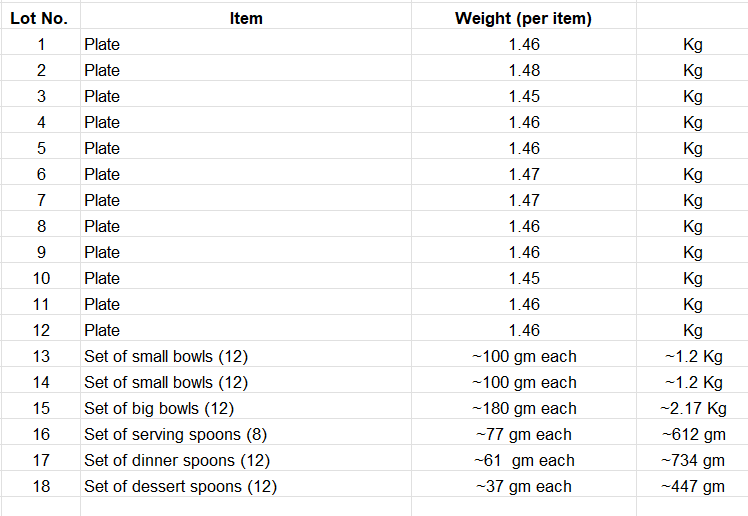
Price of every lot is equal to the (Closing price of silver on the day of purchase * actual weight + 15 %). Silver is hallmarked as 100%. Closing rate determined by Financial Express

