Narayan Shripad Rajhans was born in 1888 in Satara district, into a Chitpavan Brahmin family deeply steeped in music and theatre. In the household and within its immediate circle, music was part of devotional and everyday practice—his mother sang, and his maternal grandfather, Appa Shastri, a Sanskrit scholar, recited the Puranas at Baba Maharaj’s gatherings. It was within this environment that his earliest leanings toward the stage took root.
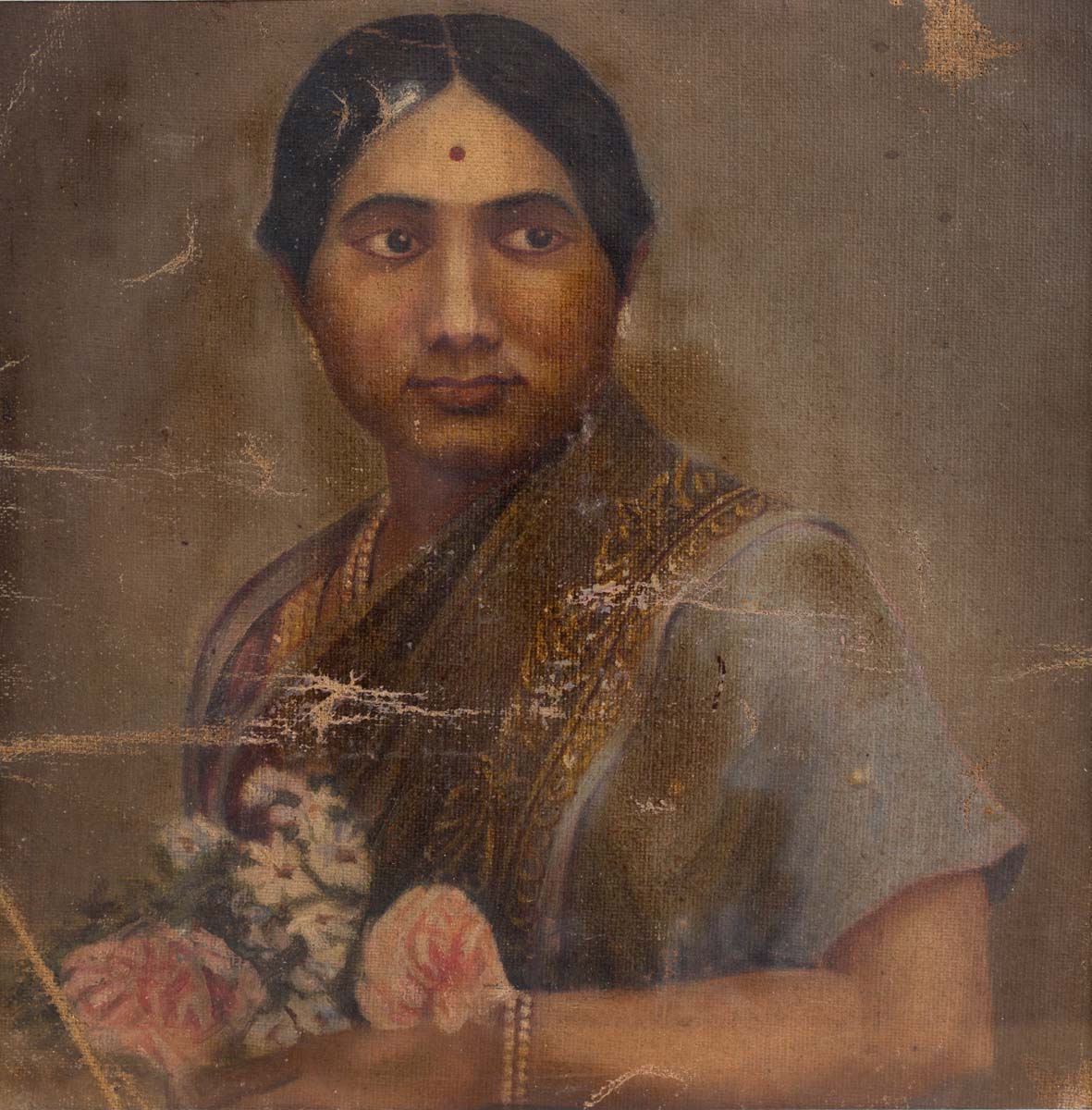
Bal Gandharva, circa 1930, circle of Baburao Painter.
Credits: The Estate of Bhanu Athaiya
As a schoolboy in Jalgaon, he gravitated toward the travelling theatre companies that set up in the town. Among them was the Kirloskar Natak Mandali, one of the most prominent Marathi musical theatre companies of the time, known for its sangeet natak—plays built around classical and semi-classical music. When the company arrived from Baroda, he would slip away during school hours and stand among the crowd. On that stage, he saw actors such as Krishna Bhoi and Bhaurao Kolhatkar perform female roles.
We used to go and just keep watching… ‘Who is this? Who is that?’ We would stand there and watch. The teacher would beat us for it, but we still went. At that time, I saw the female roles. What a match. Very beautiful. [1]
In these early years, he trained under Mehboob Khan, who taught him to sing at length. He would sing for those around him, and people gathered—offering small tokens, a scarf, or a cap. Through family and acquaintances, word of his singing reached the Kesari office. From there came an opportunity to sing before Bal Gangadhar Tilak, who was then staying near Deccan College in Pune.
He sang for about an hour that evening. Bal Gangadhar Tilak, captivated by his voice, urged him to continue. It was here that Tilak gave him the name “Bal Gandharva.” Within a few days, it appeared in print, and soon after, relatives and friends began calling him by it.
Then I said, ‘What is this?’ They said, ‘Tilak has given you the name. [1]
Entry into the Stage
By 1905, at the age of eighteen, Bal Gandharva entered the Kirloskar Natak Mandali, one of the most prominent Marathi musical theatre companies of its time, whose sangeet natak productions travelled across princely states and urban centres, shaping theatrical taste in western India. His entry into the company did not come easily. His father opposed the decision and brought him back home once, unwilling to see him take to the stage. The matter shifted only after Bal Gangadhar Tilak spoke directly to his father, assuring him of the standing of the company and the life it could offer.
“Lokmanya met my father and said, don’t worry… You will get fame, you will earn, and you will be feeding fifty or sixty people.’ After that, my father said nothing.”[1]
With this, he returned to the company, stepping into the place left vacant by the death of Bhaurao Kolhatkar, one of the earliest and most accomplished female impersonators of the Marathi stage. When he first entered the company, he was not immediately given prominence. The senior members chose to assign him a role and observe how he carried it, testing him within the structure of the troupe. It was in this context that he was given the role of Sharada, which he prepared under guidance within the company.
“When I came into Kirloskar Company, the people felt they should give me a role and see how it goes… The actress in Sharada made me memorise it… and I did the work of Sharada.”[1]
These early performances unfolded within an established hierarchy. Senior actors such as Krishnarao Gore and Bhaurao Kolhatkar had already set a standard within the company, and as a newcomer, he was made aware of his place. “As for the elders in the company, they thought a new boy has come—what value to give him… such things happened at that time.” [1]
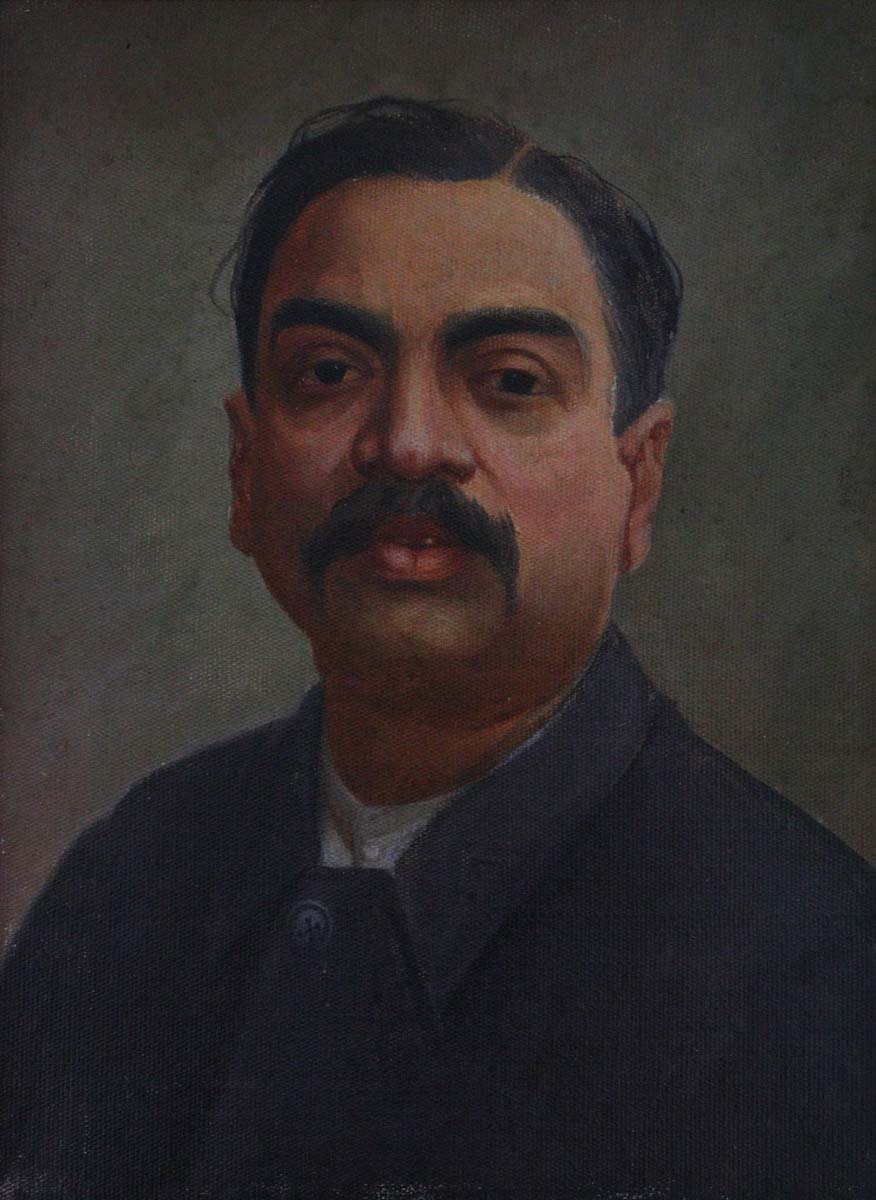
Ganpatrao Bodas, circa 1930, Circle of Baburao Painter
Credits: The Estate of Bhanu Athaiya
Among these senior figures was Ganpatrao Bodas, known particularly for his command over comic roles and his assured presence within the troupe, whose position within the company carried its own authority.
Ganpatrao Bodas used to be for comics… whatever he was doing, he was doing it right, and it was liked. Still, no one had the strength to say anything to Ganpatrao. [1]
The roles Bal Gandharva performed in these early years, particularly female roles, were not without discomfort. The construction of femininity on stage was something he was still learning, and it often resulted in moments of exposure. “We used to do female roles… there used to be cotton in the blouse, and people would see it. Many such embarrassments happened.” In the early days, before his appearance had settled into the roles he performed, he went on stage with a band tied around his head. During the performance, it slipped.
I had no hair… I had put on a band. Once the band slipped and fell… there was some hair in the front, the middle parting was to be made, and below there were balls of flowers… it became an embarrassing moment. I went inside and then put on a wig. [1]
At the same time, he remained aware that his voice had not yet reached the level expected within the company. It was here, within its discipline, that his singing began to take shape. Training came under Govind Ballal Deval—referred to within the company as Deval Master—whose methods were exacting and often difficult, demanding precision in both voice and performance. "When I went into the company, my voice was not that good… It was there that my singing happened.”
Over time, his training extended further within the company. He continued to learn from senior actors, including Ganpatrao Bodas, whose command over performance and presence within the troupe left a strong impression. He later received more structured guidance under Kakasaheb Khadilkar, whose rehearsals shaped not just individual actors but the entire ensemble. “The real education was from Kakasaheb Khadilkar… How he would teach! Not just me, but he took rehearsals of everyone.”
Among his early roles that followed was the title part in Shakuntala, performed on a newly built stage before the prince of Miraj, where his voice and stage presence began to draw attention.
Movements came, acting came, clear letters, pronunciation… rhythm came into the speech. A tune came. When saying your sentence, whatever rhythm and tune was there, the song would start in the same tune and rhythm.[1]
Within the company, speech, song, and movement were shaped together so that one flowed into the other. It was within this structure that he began to take on female roles with increasing assurance, entering them in a way he would later describe simply: “When I worked… I felt like I am the wife." [1]
The Rise of Bal Gandharva
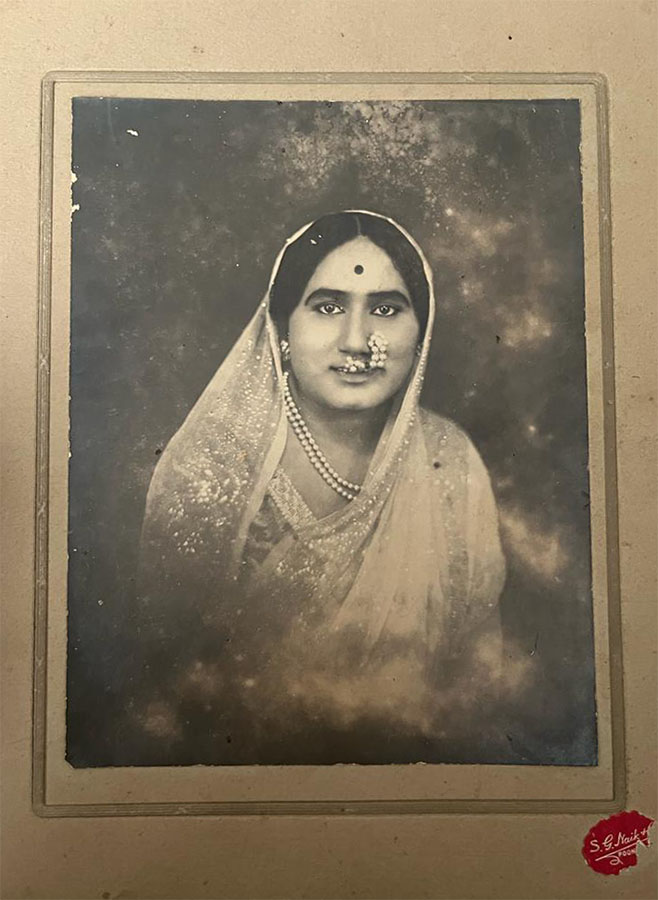
Bal Gandharva, Credits: The Estate of Bhanu Athaiya
In the early decades of the twentieth century, the Marathi stage travelled across Miraj, Kolhapur, and Pune, with its repertoire of musical plays—Manapman, Swayamvar, Menaka, Savitri—sustained by a form in which the spoken line opened into song. Female roles remained in the hands of male actors, and within this convention, Bal Gandharva distinguished himself through the particular quality of his voice. He did not employ falsetto. Instead, he sang in a register held between what would later be heard as male and female, allowing speech to move into song without rupture—“whatever rhythm was there in the sentence, the song would begin in the same rhythm.”
The manner in which Balgandharva made himself up and the way he moved on the stage fully evoked the persona of the contemporary young woman of the middle upper middle classes' [D Nadkami 1988:34]. Similarly, his songs are considered memorable for the expressivity and emotional quality in them, particularly the projection of 'shringara' and karuna. [2]
Within this evolving stage practice, changes in scenography also began to take hold. In Kolhapur, Baburao Painter—trained in painting, photography, and later known for his work in early cinema—was working across theatre companies, producing stage backdrops that brought a heightened sense of depth, detail, and atmosphere to performance. From the early 1910s, his work extended across troupes, including the Kirloskar Natak Mandali and the plays of Bal Gandharva, as well as Parsi and Gujarati theatre, where scenic elements such as painted curtains, architectural settings, perspectival views, and the use of makhmali (velvet) stage curtains were handled with increasing attention to scale and surface.
Bal Gandharva recalled encountering this most vividly in the productions of Keshavrao Bhosale, a leading actor-manager of the Marathi stage, where “Baburao Painter brought his people… they were superb… and in Rakshasi Mahatvakanksha, what great scenery there was,” noting that “Keshavrao gained this merit first. And later it came to us.” These developments moved across companies, entering the stage world within which his own performances took shape.
There were no microphones; the reach of his voice was enough. It travelled across the hall, carrying clearly to those seated farthest away. He recalled returning to the same passage within a single performance—“two, three, four times”—called back by eager audiences as an encore before the play proceeded, and remarked, “if singing becomes too much, how will it be a play?” while also acknowledging, “if a song is done well… the result increases because of their support.”
To take on the female role demanded a long practice, a sadhana through which the body learned its way into the part—the walk slowed and found its measure, the wrist turned, the gaze lowered. Through this, Bal Gandharva came on stage with long hair falling to the waist, sometimes left loose, sometimes drawn into a braid; the nath set against the face; the gait measured, assured. In Manapman, he entered with his hair undone, suggesting a woman not yet bathed; elsewhere, he turned his back to the audience and let a long, pleated braid fall into view. The gesture held within the movement of the play, drawing the eye without excess. His singing carried that same quality. It moved through shringara and karuna, held in tone and line, while the spoken word followed its cadence, shaped in an idealised register of women’s speech.
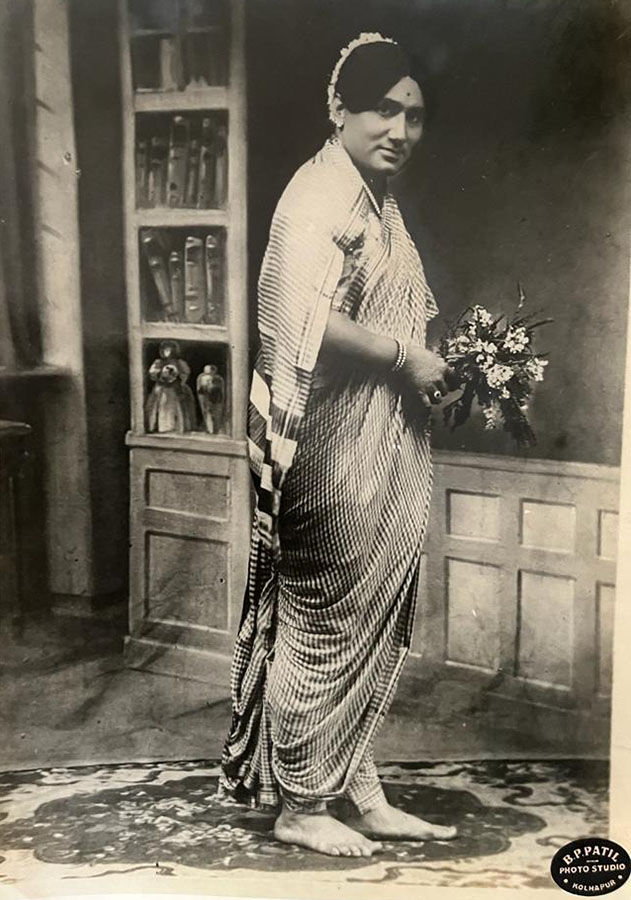
Bal Gandharva, Credits: The Estate of Bhanu Athaiya
In Maharashtra, women began to dress and adopt the mannerisms of the performer. In those days, "it was a fashion for ladies in Bombay to imitate him in their daily lives"[2] the nine-yard sari drawn longer, its pleats set in his manner, embroidered jackets worn close to the body, hair gathered into a bun with flowers placed into it, the nath set at the side of the face; the walk, too, slowed and took on that same measured gait. Soon enough, his photographs stood in drawing rooms among family portraits. His image travelled through calendars, diaries, and printed pages.
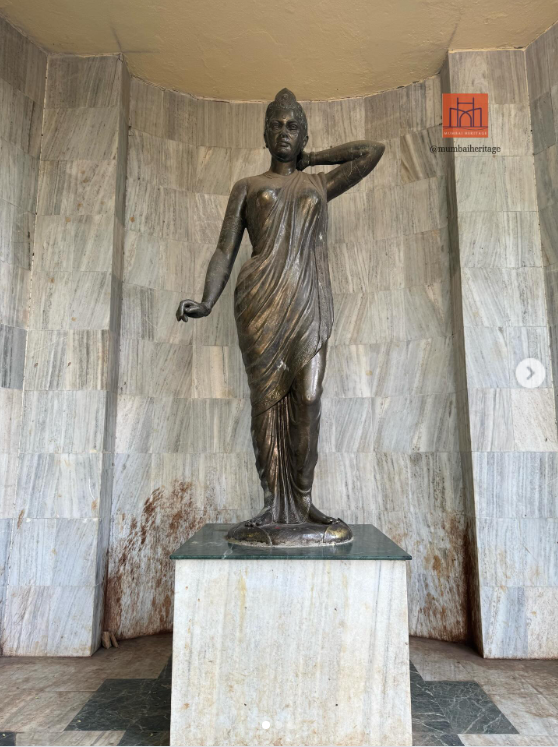
Bal Gandharva, bronze figure at Durgadevi Udyan, Mumbai Central.
Photograph courtesy: Mumbai Heritage.
Inside Durgadevi Udyan in Mumbai Central stands a bronze figure, placed within what appears to have once been a fountain. There is no plaque, no date, no clear attribution. In some older photographs, a faint “बालगंधर्व” can be made out, though it remains difficult to read today. The figure recalls the sculptural language associated with G. K. Mhatre’s To the Temple (Mandirpathagamini), though no confirmed link has been established.
Bal Gandharva remained for nearly half a century at the centre of Marathi musical theatre, his career moving with the form as it travelled across regions, audiences, and institutions. Beginning as a young singer-actor in Shakuntal with the Kirloskar Natak Mandali, he went on to perform a wide repertory of plays—classical, mythological, and contemporary—while establishing, in 1913, the Gandharva Natak Mandali, which became one of the most significant theatre companies of its time.
Under his leadership, the company grew into a large, self-contained troupe, with over a hundred members who lived and travelled together, sustaining productions through continuous touring and patronage. At the height of his career, his earnings were considerable, yet they were directed towards maintaining the company, its performances, and the well-being of its members, binding his own fortunes closely to that of the stage.
Across more than twenty-seven plays and thousands of performances, he carried female roles that came to define the visual and performative language of the Marathi stage. The styles of dress, adornment, and bearing associated with his performances entered wider circulation, taken up in everyday life and later visible in early cinematic representations that drew from theatrical practice. His singing shaped natya sangeet in performance and continued through recordings that brought stage music into domestic listening.
He received formal recognition during his lifetime, serving as president of the Marathi Natya Shatabadi Sammelan in 1944, receiving the Sangeet Natak Akademi Award in 1955, and the Padma Bhushan in 1964. In later years, after paralysis affected his health, he appeared at public gatherings where audiences continued to receive him with sustained admiration.
His life traces the course of Marathi musical theatre across its most formative decades—its expansion, its wide public following, and its institutional life—and remains closely associated with its history. By the time of his passing in 1967, Bal Gandharva had come to stand for an entire era of Marathi musical theatre. And even now, he lingers—his voice booms in the memory of the stage that once held him.
References
[1] Bhagwanrao Pandit, Interview with Bal Gandharva, recorded c. 1950–1955, Mahim, Mumbai. Video uploaded by पु.ल. प्रेम Pula Deshpande Fanblog, June 3, 2024. Courtesy: Archive.org.
[2] Hansen, Kathryn. “Stri Bhumika: Female Impersonators and Actresses on the Parsi Stage.” Economic and Political Weekly 33, no. 35 (1998)
[3] Mrinal Pande. “‘Moving beyond Themselves’: Women in Hindustani Parsi Theatre and Early Hindi Films.” Economic and Political Weekly 41, no. 17 (2006)

