Marie-Louise Chassany (Chassagny) was a French painter in the Paris art circles of the early 1930s and, for many around her, a muse. She shared a studio with Amrita Sher-Gil in Montparnasse and became a compelling presence within that artistic milieu. Tall and slender, “like a Giacometti,” [1] as one contemporary recalled, she carried an enigmatic air that drew the attention of the painters around her. Yet Chassany was not merely an inspiration for others. She was herself an artist whose work Sher-Gil admired, once likening it to the strange sensitivity of early Pablo Picasso alongside the intensity of Chaïm Soutine.
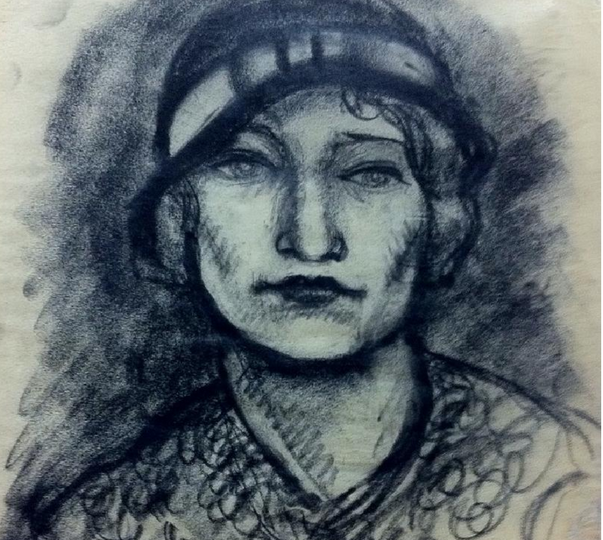
Amrita Sher-Gil, Untitled (Portrait of Marie Louise Chassany), circa 1930
A Studio in Montparnasse: Sher-Gil and Chassany
Chassany and Amrita Sher-Gil met in Paris in the early 1930s while studying at the École des Beaux-Arts, moving within the same circles of young artists in Montparnasse. Marie was among a cohort of artists trained under Lucien Simon, moving within the same academic and artistic networks that shaped Sher-Gil’s early formation. By 1933, Sher-Gil had left the school and set up a studio with Chassany at 72 rue Notre-Dame-des-Champs, marking a shift in both her working environment and her immediate circle. The space formed part of a wider milieu, open to friends and fellow artists. Sher-Gil described it as a large room with whitewashed walls, sparsely furnished, with a few Chinese paintings and works by Marie-Louise Chassany hanging on the walls.
In a composition from around 1932, Sher-Gil represented this milieu through four women in a studio interior, including Chassany, who is shown seated and reading beside Denise Proutaux (a fellow student at the École des Beaux-Arts) while an aged model poses nearby. Described as an “intense and mysterious” colleague, Chassany’s presence within this circle was also that of an interlocutor: responding to Sher-Gil’s Young Girls (1932), she remarked, “But it is sad, it’s frightfully sad,” to which Sher-Gil replied, “It only reflects my soul.” [2]
Sher-Gil in Paris: On Women and Relationships
Sher-Gil’s engagement with women in Paris extended beyond representation into her relationships. Accounts from the period suggest intimacies with women, including the Hungarian pianist Edith Lang. She herself reflected that “perhaps a relationship with women may be more pure,” even as such relationships formed part of a broader emotional life in which both men and women figured. Women recur in her work as figures marked by interiority — loneliness and unarticulated longing.
Within this context, Chassany occupies a particularly charged position. Unlike the many unnamed models or passing associations, she appears repeatedly — in the studio, in letters, and in the recollections of contemporaries.
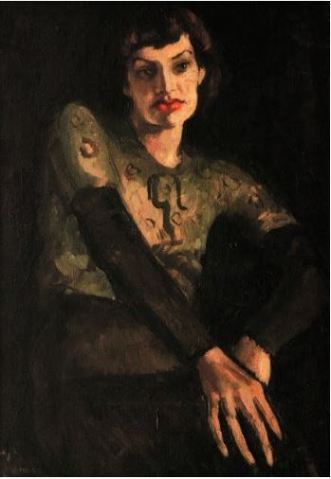
Amrita Sher-Gil, Marie Louise Chassany, 1932. NGMA Collection.
Rendered as a strong, somewhat androgynous figure, with a disproportionately large outstretched hand, her presence resists easy classification. Her face, described as mobile and shifting, carries an unsettling sense of strangeness.
The relationship between the two was marked by a certain instability. Sher-Gil described her as “a curious type of a person,” and her work as “wonderful and interesting but unhealthy,” a formulation that holds admiration and distance in equal measure. Writing to her mother in 1934, she insisted: “I never had anything to do with Marie Louise — and won’t have it either in the future.”
Yet the same letter complicates this denial. Sher-Gil notes Chassany’s behaviour as evasive and contradictory, observing:
she keeps holding my hands whenever there are people around… and every five minutes keeps on repeating how beautiful I am… But as soon as we are left to ourselves she changes immediately…

Amrita Sher-Gil, Marie Louise Chassany, circa 1932, NGMA Collection
Marie-Louise Chassany in the Paris Art World
In the work of her contemporaries, Chassany is seen with a similar intensity: Georges Rohner's Woman with a Candle (1932) paints her as a “tortured soul” in an attempt to reach her inner essence, while Robert Humblot's Woman with a Guitar places her within a still-life composition, holding a guitar among objects. Chassany was also active within the same exhibiting circuits as Sher-Gil. She exhibited alongside Gil at the Salon of the Société Nationale des Beaux-Arts in 1932, and continued to show within Parisian circuits such as the Salon des Tuileries.
Marie in Sher-Gil’s Letters
Sher-Gil’s letters also place Chassany within a small and significant circle. Reflecting on the letters she had preserved, she expressed her hope that “at least the letters of Marie Louise, Malcolm Muggeridge, Jawaharlal Nehru, Edith and Karl have been spared,” grouping Chassany among a select few whose correspondence she considered worth keeping. Writing to her sister Indira, Sher-Gil described Helen Chamanlal—whom she met in India when Barada Ukil brought her to Amrita's studio—as “only the second woman Amrita had become close to, after Marie Louise Chassany,” [3] placing Chassany at the centre of her earlier attachments.
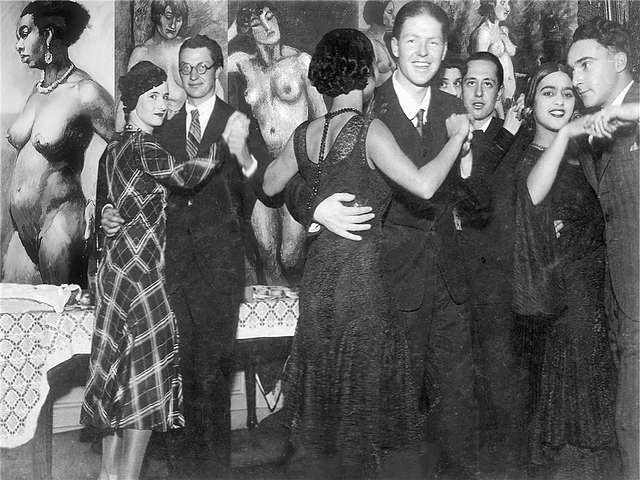
A party at École des Beaux-Arts. Amrita far-right, Marie-Louise partly visible
What place do we assign to Marie-Louise Chassany within the Paris of the early 1930s? Is she a figure within Sher-Gil’s paintings, or a painter working within the same academic and exhibiting circles? The material resists this separation. Sher-Gil writes of her at length, attempting to grasp a temperament that resists easy understanding, while her contemporaries, too, turn to her with a similar insistence, each painting her as if trying to decipher her. That she holds both these positions—the artist and the muse—points to a more complex presence within this milieu.
References
[1] Niharika Dinkar. “Amrita Sher-Gil’s Crossing Worlds.” The Gay & Lesbian Review, May–June 2025.
[2] Vivan Sundaram. “Amrita Sher-Gil and Boris Taslitzky: Or, Who is the ‘Young Man with Apples’ by Amrita Sher-Gil.” In Amrita Sher-Gil: Letters and Writings. New Delhi: Tulika Books, 2010.
[3] Yashodhara Dalmia. Amrita Sher-Gil: A Life. New Delhi: Penguin, 2006
[4] John Clark, The Asian Modern, Amrita Sher-Gil: Hungary, India, France Notes, 2013

