At Santiniketan, correspondence played an essential role in artistic life. Letters, postcards, and small drawings circulated steadily between students, teachers, administrators, and friends, creating a working network through which ideas, images, and observations moved across distances. These exchanges were not incidental. They were closely aligned with Rabindranath Tagore’s educational vision, in which learning extended beyond the classroom into daily life, travel, and conversation, and in which artistic practice was embedded within lived experience rather than confined to formal instruction.
Postcards, in particular, enabled a direct and immediate form of expression. Executed quickly—most often in ink, watercolour, pencil, or tempera- artists recorded landscapes encountered during travel, architectural details, figures from everyday surroundings, or moments of humour and reflection, alongside practical notes, administrative queries, or seasonal greetings. These images were drawn directly onto standard Indian postcards rather than specially prepared supports, reinforcing their status as informal, process-driven works. In doing so, the postcard operated both as correspondence and as a working document, closely tied to the practice of sketching that lay at the heart of Santiniketan’s pedagogy.
The Santiniketan-related letters and postcards featured in From Archives to Auction, dating primarily from the 1940s and early 1950s, offer rare insight into this culture of exchange. Addressed to figures such as Rathindranath Tagore, who served as the first Vice-Chancellor of Visva-Bharati, and Pulin Behari Sen, Director of the Visva-Bharati Granthan Vibhaga, the institution’s internal publication department, and sent from locations including Santiniketan, Ghatsila, and other travel destinations, these materials reveal how artists shaped by Tagore’s institution navigated study, mentorship, and professional life through acts of correspondence. The repeated addressing of postcards to institutional figures such as Sen suggests not only administrative communication but also an ease of intellectual access between students, artists, and cultural stewards within Santiniketan’s milieu.
Prosanto Roy and Santiniketan’s Culture of Correspondence
Among the artists shaped by Santiniketan’s intellectual environment was Prosanto Roy (1908–1973), whose career was closely entwined with the institution’s artistic and administrative life. Roy joined the Brahmacharya Ashram at Santiniketan at the age of thirteen and came under the influence of Rabindranath Tagore’s educational philosophy at an early stage. His artistic training developed through close contact with figures associated with Kala Bhavana and Jorasanko, including Abanindranath and Gaganendranath Tagore, with whom he later worked on stage design, illustration, and pedagogical projects.
Roy’s practice was grounded in observation of nature, and this sensibility extended into his correspondence.
.jpg)
Prosanto Roy's letter to Rathindranath Tagore, dated 28 May 1950
A letter dated 28 May 1950, addressed to Rathindranath Tagore, combines a pen-and-ink sketch of the Konark temple with written communication; the letter situates Roy within Santiniketan’s administrative and cultural framework at a moment when the institution was negotiating its post-Independence identity. Roy’s correspondence with Rathindranath Tagore was rather frequent. In an earlier auction, another illustrated letter by Prosanto Roy, dated 29 July 1950, addressed to Rathindranath Tagore, was recorded. That letter similarly combines text with a painted image—this time a watercolour view of Kalimpong. By this time, Roy was already an established figure within the Santiniketan circle and would shortly be appointed Curator of the Kala Bhavana Museum in 1952—a role that formalised his long-standing engagement with the institution’s artistic legacy.
.jpg)
Prosanto Roy's letter to Rathindranath Tagore dated 29th July 1950
Shailesh Chandra Deb Barma: Student Correspondence from Santiniketan
The culture of correspondence at Santiniketan is seen with particular clarity in the postcards and letters sent by Shailesh Chandra Deb Barma. At the time, Deb Barma was a student at Kala Bhavana, writing to Pulin Behari Sen, Director of the Visva-Bharati Granthan Vibhaga, the institution’s internal publication department established in 1923. The concentration of such student correspondence addressed to Sen underscores his role not merely as an administrator but as a trusted interlocutor within Santiniketan’s intellectual ecosystem, someone with whom students felt comfortable sharing informal observations, drawings, and speculative artistic ideas
.jpg)
Shailesh Chandra Deb Barma, Untitled (Landscape with Tree), 1960, Watercolour on Postcard
Composed on the occasion of the Bengali New Year (1 Baisakh, 1350), the letter and four illustrated postcards combine text, drawing, and informal observation. Deb Barma writes about his artistic plans—mentioning proposed works based on the Mahabharata and the life of the Buddha—while also referring to contemporary publications connected to Santiniketan, including works by Abanindranath Tagore. The tone is personal and unguarded, reflecting the ease with which students communicated with administrators within Tagore’s educational environment.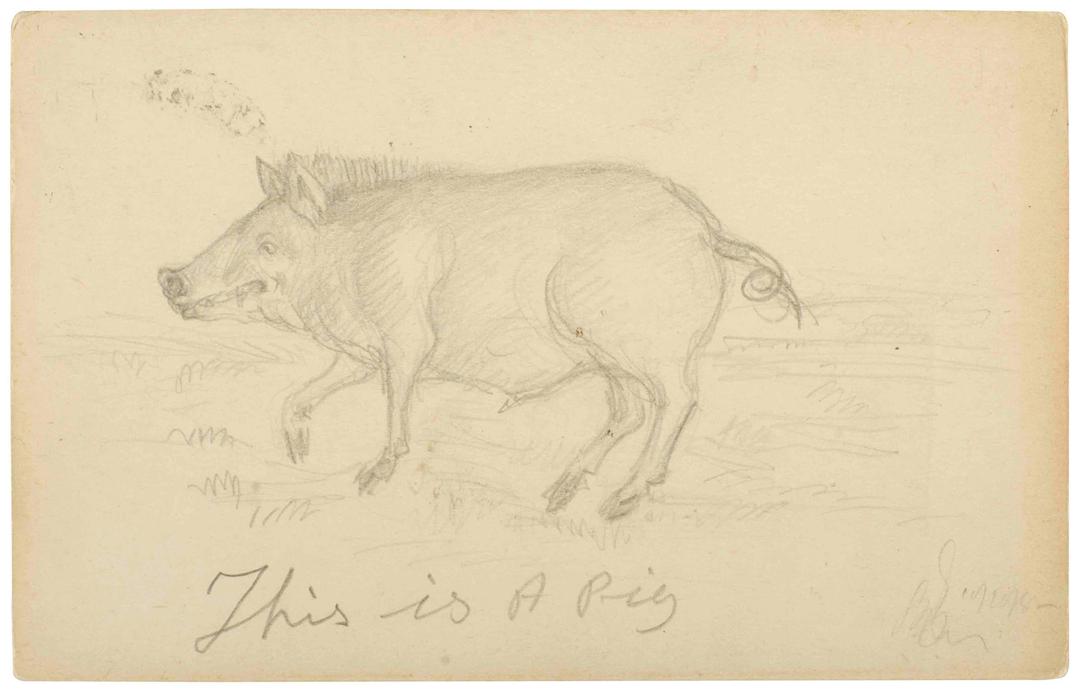
Shailesh Chandra Deb Barma, Untitled (This is a Pig), 1956, Pencil on Postcard
The drawings themselves are modest in scale and direct in execution, characteristic of postcard practice at Santiniketan. One postcard includes a humorous caricature of a pig, accompanying Deb Barma’s enquiry about the Principal of the Government Art College, Calcutta, revealing the informality and wit that often marked student exchanges.
Deb Barma would later go on to teach for several decades at Rabindra Bharati University, becoming part of the post-Independence generation that carried Santiniketan’s pedagogical ethos into new institutional settings. These early postcards, however, remain valuable precisely because they capture an artist still embedded in the rhythms of learning, writing, and drawing that defined everyday life at Santiniketan in the 1940s.
Landscape as Exchange: Postcards Signed “Ramen”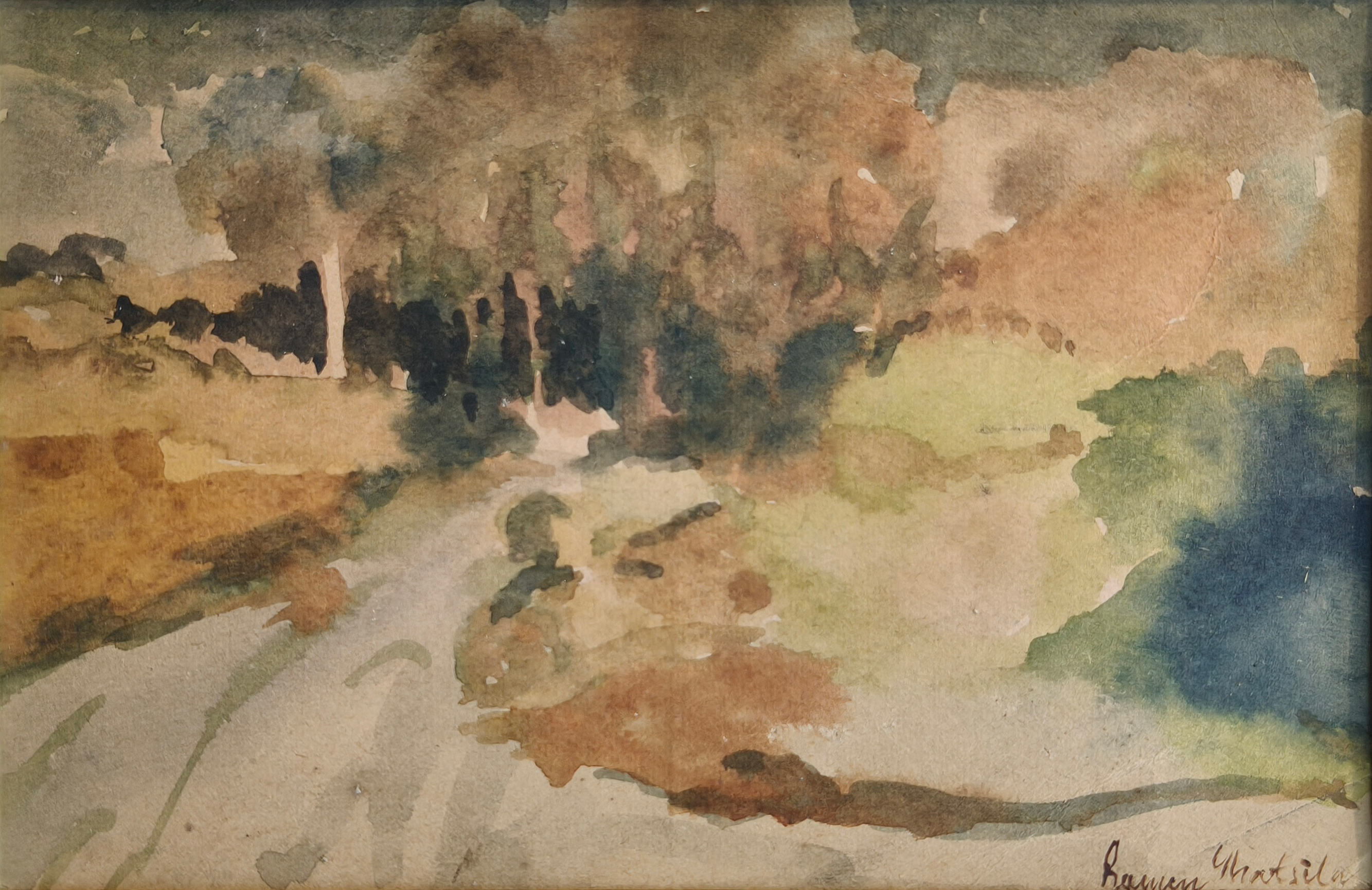
Ramendranath Chakravorty, Untitled (Ghatsila), indistinct
A further dimension of this correspondence emerges in two painted postcards, signed “Ramen,” and one of them sent from Ghatsila to Pulin Behari Sen, Director of the Visva-Bharati Granthan Vibhaga. .jpg)
Ramendranath Chakravorty, Untitled (Kaliyug), 1955
These works are provisionally attributed to Ramendranath Chakravorty, the Santiniketan-trained artist who later served as Principal of the Government School of Art, Calcutta, and played a formative role in Indian printmaking education. Another card bears a handwritten inscription that appears to read “Kaliyug,” recorded here as indistinct. While attribution remains cautious—several Santiniketan-affiliated artists signed their correspondence simply as “Ramen”—the postcards are firmly situated within Santiniketan’s visual culture, reflecting its emphasis on direct observation, lyrical landscape, and the postcard as a vehicle for artistic exchange.

