The audiences who wept through Satyajit Ray's Pather Panchali, with its kash flowers, rain-soaked landscapes and the first stirring of Apu’s world; who watched Meena Kumari as Chhoti Bahu in Sahib Bibi Aur Ghulam, where Bhanu Athaiya’s painterly sense allowed saris, borders and translucent layers to carry emotion through the greys of the black-and-white screen; who recognised themselves in Amol Palekar’s gentle, unheroic presence in Chhoti Si Baat and Gol Maal, were responding to three artists whose work had entered public memory through film.
Satyajit Ray, Bhanu Athaiya, and Amol Palekar span a remarkable breadth of Indian cinema: intimate and epic, regional and national, artful and deeply popular. What has remained largely unexamined is the artist’s eye each brought to cinema, and how profoundly their lives before film shaped the visual culture of Indian cinema.
Satyajit Ray at Santiniketan
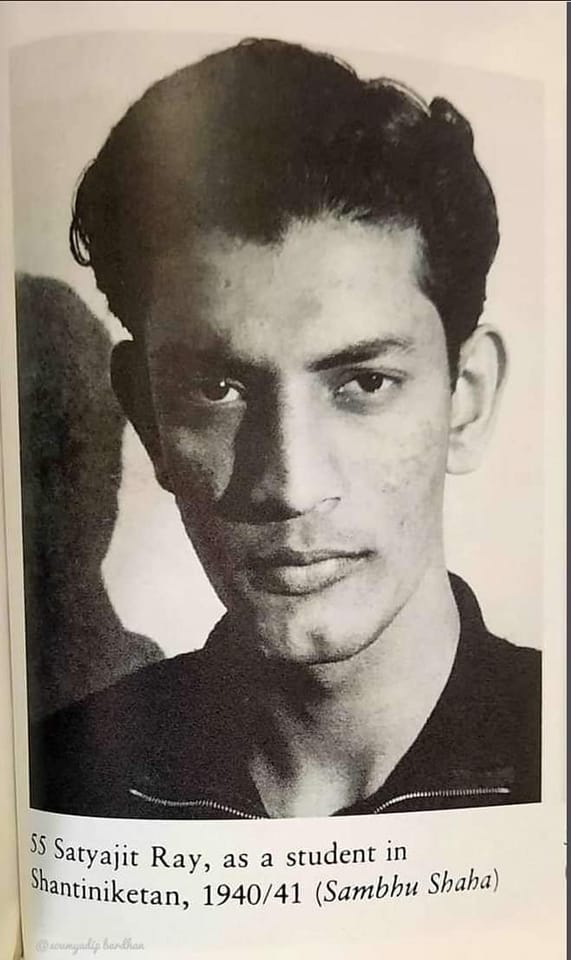
Satyajit Ray, Santiniketan
Picture Credits: Facebook, Satyajit Ray Followers
Satyajit Ray arrived at Santiniketan in July 1940, during the rains, after completing his studies at Presidency College. He was twenty, deeply attached to Calcutta, close to his mother, Suprabha Devi, and drawn to books, illustration, music, and cinema. Santiniketan did not immediately win him over. Calcutta had cinemas, concerts, cricket and football matches, bookshops, records, and the movement of a city alert to the war years; Santiniketan had quiet, open air, slow rhythms, long hours of work, and no cinema hall. Yet the very place that unsettled him became one of the decisive sources of his visual education.
I consider the three years I spent in Santiniketan as the most fruitful of my life… Santiniketan opened my eyes for the first time to the splendours of Indian and Far Eastern art. Until then I was completely under the sway of Western art, music and literature. Santiniketan made me the combined product of East and West that I am.
- Satyajit Ray
Ray’s journey to Santiniketan was tied to Rabindranath Tagore’s long association with the Ray family. Tagore had known the world of Upendrakishore Ray Chowdhury and Sukumar Ray, and he wished for Sukumar’s son to spend time at Visva-Bharati; Suprabha Devi, who had raised Satyajit alone after Sukumar’s death, appears to have honoured that wish even though Ray himself was unsure about leaving Calcutta. Another memory takes us back to his childhood, when Tagore wrote a short poem for the seven-year-old Satyajit about travelling to distant mountains and seas and yet failing to notice, just two steps from home, a dew drop on a paddy ear, adding that the boy would understand its meaning when he was older. That small image of attention — the world found in the near, the overlooked, the minute — acquires resonance when placed beside Ray’s later cinema, where large histories often enter through intimate spaces: a room, a courtyard, a train line, a window, a face listening, a household object held within silence.
At Kala Bhavana, Ray entered the world of Nandalal Bose, whom students called Master Moshai, and of Benode Behari Mukherjee, Ramkinkar Baij, Surendranath Kar, Gauri Bhanja and others. His letters to his mother preserve the working texture of this education: blackboard drawing, brush transfers on brown paper, copies after Ajanta, linocuts, modelling, anatomy, design and alpana. In one letter, he wrote that he had transferred fifteen copies of Ajanta paintings directly with the brush in three hours; in another, he noted that Nandalal had asked him to copy difficult portraits from the Old Masters so that errors in light and bone structure could be corrected. Santiniketan also opened before him Indian sculpture, miniature painting, Japanese woodcuts and Chinese landscapes, while sketching trips to nearby villages brought the Calcutta-bred student into contact with rural Bengal.
The Santiniketan world that shaped Ray was never narrowly nationalist. Nandalal Bose’s teaching drew deeply from Indian traditions, yet it also welcomed Japanese and Chinese painting, treating influence from outside India as something to be studied, absorbed, and made one’s own. This openness helps explain why Ray later described Santiniketan as the place that made him “the combined product of East and West”: Kala Bhavana gave him an Indian visual grounding, but one that remained international in temperament.
The education also moved beyond the studio classroom. Rehearsals of dance-dramas and theatrical plays took place at Uttarayan in Rabindranath’s presence, and Ray was present on many such occasions; after Tagore’s death, he watched Abanindranath Tagore directing Valmiki Pratibha, writing to his mother of Abani babu’s genius in acting, music and direction.
When Ray returned to Calcutta in 1942, he carried Santiniketan into another world of image-making. He worked for nearly a decade as a layout artist and art director in a British-run advertising agency, while his reputation as a graphic artist brought book illustration commissions, including an abridged edition of Bibhutibhushan Bandyopadhyay’s Pather Panchali in 1946. Before he filmed Apu’s world, he had already approached it through illustration, layout, and giving visual form to a literary world.
Ray’s relationship with Tagore also entered his early film imagination. In 1948, before Pather Panchali, Ray and Harisadhan Das Gupta planned an adaptation of Tagore’s Ghare Baire, with Ray writing the script and Das Gupta to direct; when a producer asked for changes, Ray refused, and the project was abandoned. Ray returned to the novel decades later in Ghare Baire / The Home and the World (1984), bringing Tagore’s story of nationalism, domestic life and moral conflict into his mature cinema.
Ray’s later comments on filmmaking show how this earlier visual training remained part of his practice. In a Prasar Bharati interview, he recalled his gradual involvement in screenplay, casting, editing, music, set ideas and camera operation, explaining that he began operating the camera from around Charulata because “it was through the camera that one was able to judge the action and the movement of the actors best rather than sitting in a chair by the side.” In the same interview, he spoke of Darjeeling’s weather while making Kanchenjunga, where rising mist, disappearing mist, the sun being covered by clouds, and the falling light between four and six in the evening became part of the film’s structure and mood.
Benode Behari Mukherjee remained an especially important figure in Ray’s later memory of Santiniketan. Ray made The Inner Eye in 1972 because, “Vinodada attracted him”; in another interview, he called Benode Behari his art teacher at Santiniketan, “a remarkable man” and “a remarkable painter.” The documentary returned Ray, through cinema, to one of the teachers who had shaped his understanding of art, sight and inner vision.
Bhanu Athaiya: Kolhapur, J.J. School and Cinema’s Vast Costume World
Bhanu Athaiya’s creative journey began in Kolhapur, where painting, theatre, music and early cinema co-existed. She later compared the city to Paris, saying that “instead of the Seine, we had the Panchganga." In her recollections, Kolhapur was a living artistic environment of temple courtyards, riverbanks, palace collections, travelling theatre, devotional music, painters with portable easels, and early filmmakers who moved between painting, sculpture, theatre scenery, and the camera.
Her father, Annasaheb Rajopadhye, introduced her to art and cinema; her mother, Shantabai, specialised in embroidery and had won a gold medal at the Grahini Vidya Shala Exhibition in Kolhapur, signed by Abalal Rahiman and Baburao Painter. Abalal Rahiman, one of the region’s earliest formally trained artists, had studied at the Sir J.J. School of Art and later served as court painter under Shahu Maharaj, while Baburao Painter painted in oils, made sculpture, designed theatre backdrops and founded the Maharashtra Film Company in 1918. Through such figures, Bhanu’s childhood was linked to a Western Indian art world in which painting, performance and cinema were already in conversation.
Maharani Radhika Raje Gaekwad recalled Bhanu’s own words about textiles, and the memory is important because it returns the future costume designer to touch, colour and childhood sensation:
I grew up feasting my eyes on the exquisite beauty of these gorgeous saris. Feeling their textures, enjoying their color combinations, tracing the motifs with my fingers was heady stuff for me in my childhood and it propelled me on a journey into the world of textiles.
Theatre entered this childhood through Marathi sangeet natak and the legendary figure of Bal Gandharva, whose female roles shaped public ideas of beauty, gesture and dress. In this theatrical world, sari, jewellery, coiffure, voice and movement made the performer legible to the audience. For Bhanu, who would later transform costume design in Indian cinema, such memories offered an early lesson in how fabric and gesture could alter presence.
At the Sir J.J. School of Art, where Bhanu studied from 1947 to 1953, this early visual world was sharpened by formal training. She studied anatomy through live models, made figurative drawings, copied temple sculpture and trained under Jagannath Ahivasi, who was associated with the Bombay Revivalist movement. Looking back, she described miniature painting with striking directness:
“The only authentic Indian art was the study of miniature paintings which I was learning under professor Jagannath Ahivasi.”
The same source records her explanation of J.J.’s double inheritance: academic studies required sketching live models to understand anatomy, while miniature painting offered a way to adapt an Indian compositional style to contemporary painting. This combination is important because it places Bhanu at the meeting point of two kinds of training: the body studied through academic drawing, and Indian form studied through miniature painting.
Her painting The Brahmins gives this training a more intimate colour. Ahivasi noticed the strong rust and maroon tones in the work, and Bhanu connected them to the colours worn by widows she had seen in temples near her house in Kolhapur. The memory is precise and visual: women in temple spaces, rust and maroon saris, ritual listening, remembered colour entering the painted surface. The work carries the influence of miniature composition and the atmosphere of a childhood place translated into art.
Bhanu’s seriousness as an artist was recognised early. In 1951, she won the Usha Deshmukh Gold Medal at J.J. School for Lady in Repose, and later recalled that this achievement brought her to the notice of the Progressive Artists’ Group:
My studies for painting at the J.J. School of Arts were going very well, where I won the Gold Medal. That Gold Medal and my achievement in the final exams brought me to the notice of the Progressive Artists’ Group, and they asked me to be a member of their group and exhibit along with great artists like Ara, Raza, and the big names of the era.
The J.J. years also placed her within a wider modernist argument. Gayatri Sinha notes that Bhanu’s surviving works from roughly 1949 to 1952 move between academic figure study, abstraction, Post-Cubist imagery, Indian miniature influence, colourist skill and the wider question of indigenism and modernism within art education after Independence. Her works Prayer and Bananas were shown at the Bombay Arts Society Salon in 1952 after H. A. Gade invited her to exhibit with the Progressive Artists’ Group, and Sinha describes her as having made her mark as an “intrepid modernist” within that circle.
By the close of 1952, as several Progressive artists looked outward to Paris, Mexico and other centres of international modernism, Bhanu made a different decision. In a 2010 interview with Manjula Sen, she put it with memorable economy
“South Bombay had painters, north Bombay had the cinema world. I chose working with (the) camera.”
In her handwritten notes, she would return to this dilemma with even greater intensity, writing that cinema did not discount her art education because it was “a new emerging form of creativity” and that she was able to “carry my art into cinema”; she also recorded that some members of the PAG, including K. H. Ara, felt she should continue painting and thought she was “degrading” herself by moving to cinema.
Cinema gave Bhanu another field of practice, one that joined drawing, textile, research, theatre, fashion and the public imagination. In Aas (1953), her first film project with Kamini Kaushal, she designed for a modern young woman, and the now-famous outfit with a transparent net yoke, lace sleeves, and a sweetheart-cut neckline already showed how boldly she could read character through cut, fabric, and mood. Through films such as Shri 420 (1955), C.I.D. (1956), Pyaasa (1957), Kaagaz Ke Phool (1959), Sahib Bibi Aur Ghulam (1962), Guide (1965), Amrapali (1966), Meera (1979), Gandhi (1982), Razia Sultan (1983), Lagaan (2001) and Swades (2004), her work moved across modern urban women, courtesans, aristocratic interiors, ancient republics, devotional worlds, colonial histories, rural communities and ensemble scenes involving multiple classes, regions and nationalities.
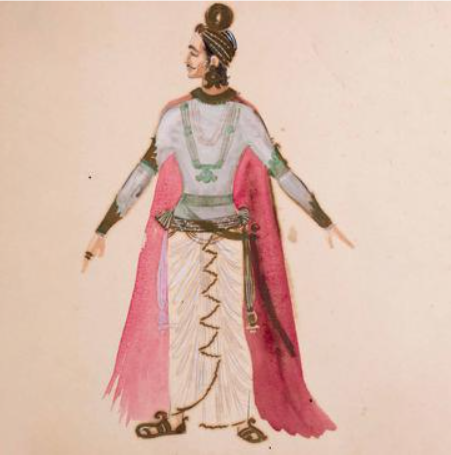

Costume drawings by Bhanu Athaiya for historical films such as Amrapali and Razia Sultan
©Prinseps
The scale of this work was extraordinary. Sinha notes that in the six decades between 1953 and 2014, Bhanu worked on 294 films, averaging about five to six films a year, and that she created a genuinely pan-national style that did not simply mimic any one region. Her costume sketches, especially for films such as Amrapali and Razia Sultan, show this process at its clearest: character, period, silhouette, jewellery and drape first appear as drawings before they become garments for the screen.
Research was at the core of her practice. For Sahib Bibi Aur Ghulam, she went to Calcutta to study old houses of the landed aristocracy, looking for the atmosphere of zamindari decline; for Amrapali, she drew on armour studies she had made two decades earlier at the British Museum, material that later also informed Razia Sultan. Ritu Kumar, speaking at the Prinseps exhibition, described the difficulty of such work in a time before Google, Instagram or accessible books on Indian garment history, when references for women’s dress, especially within aristocratic interiors, were scarce or hidden, and when the designer had to travel, infer, observe and reconstruct.
Ritu Kumar’s reflections on Sahib Bibi Aur Ghulam make this vivid. She spoke of Bengal aristocracy, the difficulty of entering the women’s world of the inner quarters, and the absence of clear visual records for what women wore, before describing how Bhanu worked with net and borders to create Meena Kumari’s look in the film. Such remarks show the kind of imaginative reconstruction required of a designer working between history, censorship, cinematic desire and available evidence.
To translate everything in shades of black and white was an experience by itself. I inserted a few colours here and there, knowing the tonality they would create on the screen.
Her work on Gandhi brought this research discipline to an enormous scale. Ritu Kumar called it a “phenomenal achievement,” especially because the production required thousands of people to appear as though they were wearing khadi at a time when handloom availability and historical references were far from easy. She recalled asking Bhanu how she had done it, and Bhanu’s reply was stark: “I didn’t sleep I didn’t eat for months.” The Oscar she won for Richard Attenborough’s Gandhi in 1983 is often remembered as India’s first Academy Award, but the anecdote restores the labour behind the honour: research, sourcing, fabric, authenticity, scale and exhaustion.
Her daughter Radhika Gupta’s brief remark at the same exhibition also restores Bhanu as an artist of paper and line. She remembered that her mother was “a book person and an art person totally,” and that her sketches were “more precious to her than saris and jewelry.” Kiran Nadar, reflecting on the exhibition, said that seeing Bhanu’s paintings helped her understand that:
the depth of what she did in her costume designing came to a large extent from what she had put down in her paintings.
Mita Vashisht’s testimony adds the actor’s body to this history. Speaking of Bhanu’s costumes for Kumar Shahani’s Khayal Gatha and for Veenapani Chawla’s A Greater Dawn, she recalled that a costume designer could “make or break” an actor’s ability “to walk, to stand, sit, dance, cry, laugh,” and said that when Bhanu put a costume on an actor, “it was like she had put on a second skin.” For A Greater Dawn, a movement-based production inspired by Sri Aurobindo’s Savitri, Mita remembered approaching Bhanu because, in her view, only Bhanu could make a costume that would allow the required movement; Bhanu came to see the rehearsal, agreed to do the costume, and asked only for the cost of fabric and tailoring. “Bhanu’s costumes were a dream for actors,” Mita said.
Alaknanda Samarth’s earlier tribute gives a similar glimpse of Bhanu at work during Kumar Shahani’s 1987 productions of Kunti and The Human Voice. She remembered Bhanu sitting quietly in a corner of the rehearsal room, “sketchpad in hand, head lowered,” while Samarth rehearsed for eight hours a day. The costumes, she wrote, gave her “fluidity, freedom, shape, and emotional texture,” and Bhanu’s understanding of fabric and lighting gave them “a contrasting luminosity, a lightness.”
Such testimony is valuable because it shows Bhanu’s costume work from within performance. The costume was not a garment made only to be admired, or a period reference assembled for accuracy; it had to sit on the actor, respond to light, carry emotional tone, and allow movement. Her art-school training, Kolhapur memories, miniature studies, theatre awareness and deep research converged in that space between the sketch and the performer.
Amol Palekar: Painting, Theatre and Space
Amol Palekar enters this history through a later Bombay world, closer to experimental theatre and post-Independence artistic practice than to the revivalist debates surrounding Ray and Bhanu. A postgraduate in Fine Arts from the Sir J.J. School of Art, Palekar began his artistic career as a painter in 1967, a career marked by seven solo exhibitions, two murals for the Bombay Port Trust and participation in many group shows. His later popularity as the gentle, middle-class “boy next door” in Hindi cinema has often overshadowed this earlier and continuing life as a painter.
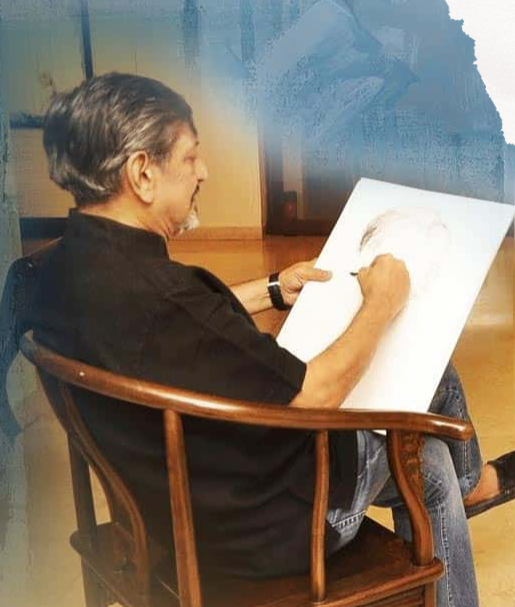
Picture Credits: Amol Palekar Website
Palekar’s own account makes the overlap between painting, theatre and cinema especially clear. He has said that his first solo exhibition took place in 1967, his film career began around 1968, and his first theatre direction came in 1969, so that these three areas began almost together. With characteristic humour, he described himself as “an actor by accident, artist by nature, producer by compulsion and director by choice,” while also insisting that he was a qualified artist from J.J. School, trained in mural painting, working in oils on canvas, and now almost a full-time painter again.
Now that I often retrospect, I feel Camus’ words etch out through my 50 years’ career ‘ I rebel, therefore I exist’. I started as a painter, perhaps will end as one!
His reflections on space give the strongest bridge between his art training and his later theatre and cinema. Asked what drew him across visual and performing arts, Palekar replied:
I guess I experimented with the ‘space’ whether its 2 or 3 dimensional… explored its visual possibilities. Space and visuals are like a circle and a center of that circle… non-existent without each other. I guess I am inseparable from being an artist.
His theatre career began in the same period, after he met Satyadev Dubey in 1967. Palekar became one of the important figures of the Chhabildas Theatre Movement, which brought offbeat and parallel theatre into a school hall in central Mumbai, and his work as actor and director moved through plays such as Chup! Court Chalu Hai, Adhe Adhure, Hayavadan, Badal Sircar’s Vallabhpurchi Dantakatha, Pagla Ghoda and Juloos, and works by C. T. Khanolkar, Achyut Vaze and Mahesh Elkunchwar. In 1972 he formed Aniket, and productions such as Gochee, Chal Re Bhoplya Tunuk Tunuk and Juloos were performed outside conventional auditoriums, in gardens, garages, canteens, foyers and terraces.
For Palekar, theatre offered a “real space” in which composition, layout, light, shadow, movement, sound and the live human presence could be worked through directly. He recalled reacting against both large, heavily orchestrated productions and unimaginative drawing-room sets, choosing instead to work without realistic props, to use the human body and lights as primary tools, to play with darkness and shadows, and to move theatre beyond the proscenium. His description of pause and silence is particularly close to a painter’s understanding of surface: “the blanks are as significant and meaningful as the filled portion of a canvas.”
What does it mean that three of Indian cinema's most distinctive visual sensibilities were shaped in painting studios, art school classrooms and theatre rehearsal rooms? Ray's landscapes, Athaiya's costumes, Palekar's silences — each carries within it the residue of a long artistic formation, of years spent in the study of colour and form and fabric and space under teachers like Nandalal Bose and Jagannath Ahivasi. To look closely at their work is to understand that Indian cinema's visual culture was always in conversation with painting, theatre and textile — and that this conversation, carried forward by artists of deep seriousness and formed sensibility, is what gave Indian cinema its particular richness and depth.
References
- Emami Art. “Satyajit Ray at Kala Bhavana.” Emami Art, February 8, 2023.
- Ray, Satyajit. Quoted in “Tagore and His India.” The Nobel Prize, August 28, 2001.
- Prasar Bharati Archives. “Rare Interview of Captivating Filmmaker Satyajit Ray.” YouTube.
- Reader’s Digest India. “13 Lesser-Known Facts About Satyajit Ray On His 99th Birthday.” Reader’s Digest India, May 2, 2020.
- Turner Classic Movies. “Satyajit Ray.” TCM.
- Sinha, Gayatri. “Art and Design in the Life of Bhanu Athaiya: Realizing a Dream.” Prinseps.
- Prinseps. “Bhanu Athaiya: A Synopsis.” Prinseps.
- Athaiya, Bhanu. The Art of Costume Design. Noida: HarperCollins, 2010.
- Sen, Manjula. “Interview with Bhanu Athaiya.” The Telegraph, April 4, 2010.
- Athaiya, Bhanu Rajopadhye. “Bhanu Rajopadhye’s Association with the Progressive Artists’ Group.” Dictated note, Bombay, May 2010. Courtesy Prinseps.
- Prinseps. “Bhanu Athaiya’s Feminist Vision.” Prinseps.
- Samarth, Alaknanda. “Tribute to Bhanu Athaiya.” London, November 2020. Included in Prinseps, “Bhanu Athaiya: A Synopsis.”
- Palekar, Amol. “Non-Conformist Voyage of Life.” Amol Palekar Official Website.
- Palekar, Amol. “Amol Palekar: India Needs the Ambiguity of Grey, Not the Intolerance of Black & White.” The Wire, December 26, 2018.
- Waheed, Saman. “Exciting Art Can Be Created Through Participative Dialogue: Amol Palekar.” Ashoka University, August 29, 2022.
- Times News Network. “I Find Facing a Blank Canvas the Most Challenging: Amol Palekar.” The Times of India, November 25, 2014.

