A founding member of the Progressive Artists’ Group and one of the first Indian modernists to incorporate abstract expressionism into their artworks post-independence, Hari Ambadas Gade is known for his abstract landscape compositions and vibrant colour palette. Working against the dominance of western academic realism under the British Raj, he developed a vivid, structurally driven visual language that remains singular within modern Indian art.
I met a small band of artists such as Husain, Ara, Raza, Newton (Souza) who were trying to leave the trodden path of the Bombay traditions—bad, realistic Victorian style—and find new approaches for their visual and emotional expressions. They had not yet formed a group. They saw in my work something different and promising, and in tune with their own understanding and approach. And when they formed a group, they invited me to join it.
- H. A. Gade on joining the Progressive Artists’ Group (1)
Born in Amravati, Maharashtra in 1917, Gade graduated in science from the University of Nagpur. His background in science often seeped into his artworks, characterised by structured and geometrical forms that almost faintly echoed cubism. Gade submitted 2 of his paintings at a national exhibition in Nagpur, 1946, winning a prize for one of his figurative works. He enrolled into the Nagpur School of Art to pursue his Diploma in Art in 1949, and later, a master's in Fine Arts in 1950.
Gade’s penchant for art developed early in his childhood. From a tender age, he spent his days sketching, and even while studying science in Nagpur, he continued to draw in his spare time. While he began experimenting with watercolours at the beginning, he later moved to work more with oils on canvas. During his studies, Gade also crossed paths with S.H.Raza, who guided him through the nuances of landscape painting. Gade's canvases were worked on with both palette knife and brush, lending his surfaces a distinctive textural richness.
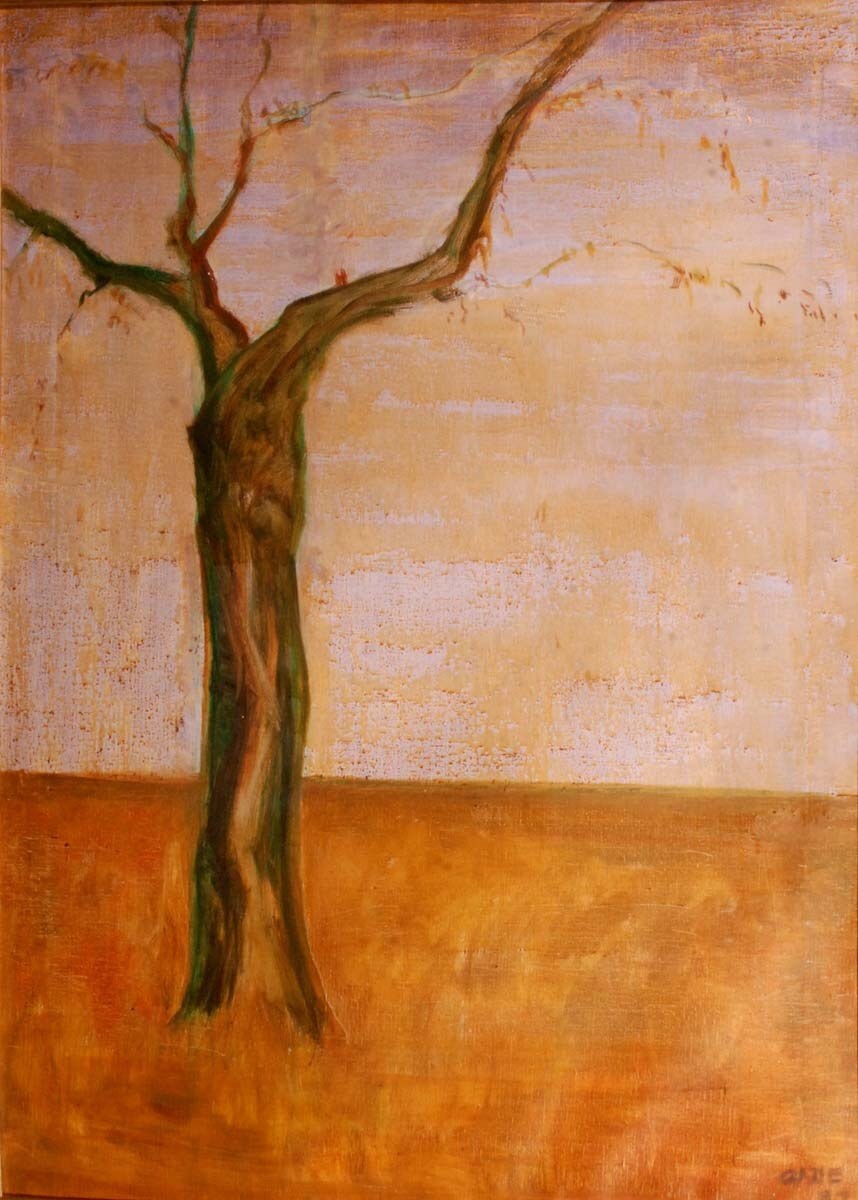 H. A. Gade, UNTITLED (Tree), Oil on canvas, 1982.
The above painting exemplifies his command of the medium, presenting a solitary tree set against a warm ochre ground. Within Gade’s practice, colour holds a place of great importance. Gade brings together the vocabulary of the landscape with a modern, almost abstract sensibility, capturing the essence of nature in brilliant hues.
“I am obsessed by colour. I speak in colour. A painter must be a colourist first, whatever else he may or may not be.”
-H. A. Gade (1)
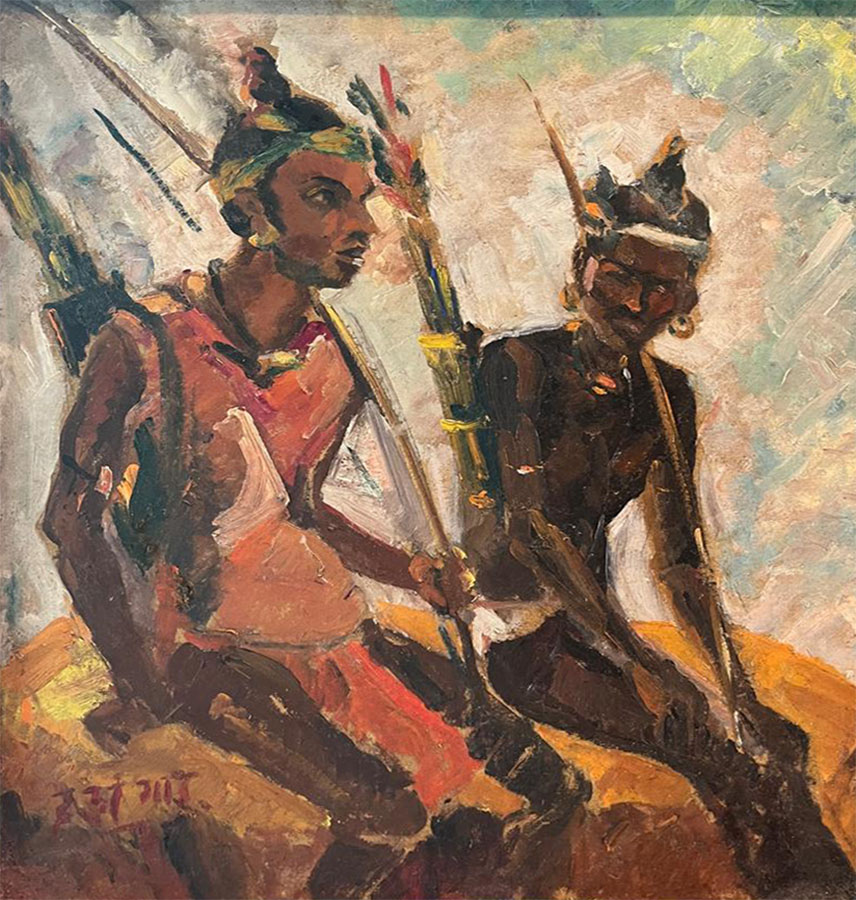 H. A. Gade, Men from the Forest, Oil on Canvas, c. 1948
Gade’s vibrant landscapes were often born out of his frequent travels across India, from the barren deserts and royal palaces of Udaipur to the verdant flush of Kerala. Gade also travelled through dense forests, observing the foliage, the wildlife and people closely before painting them in a rich palette of warm ochres and browns, like the one above. The artwork was also a part of the International Contemporary Art Exhibition, New Delhi and the All India Exhibition of Painting and Fine Arts, 1948 held in Nagpur.
I have come to believe that pictorial truth is a self-contained phenomenon within the limits of the medium, and visual imagery is only a means to arrive at this truth. Therefore, I have no story to tell, no literary message to give, no social commentary to make in my pictures.
-H. A. Gade (2, 3)
In the early years of independent India, Gade returned to Bombay and shifted his focus from painting landscapes to the shifting urban landscape of the city driven by rapid development alongside the rise of slums. Aside from his famed landscapes and cityscapes, Gade’s vast body of work also included still lifes, nudes and portraits.
Gade exhibited extensively in India and internationally, notably at the Venice Biennale in 1954. However, the seminal exhibition that set the foundation for his successes to come was his first show with the Progressive Artists’ Group in 1948. In 1949, he was invited to exhibit at the Salon de Mai in Paris, and also presented his work at Stanford University that same year. His achievements were recognised with several honours, including the Bombay Art Society’s gold medal in 1956, the Maharashtra State Exhibition Award, and a prize at the Saigon Biennale in 1962.
References:
- Kishore Singh, Colourist Non-Pareil (Critical Collective)
- H. A. Gade Exhibition Catalogue, Dhoomimal Gallery, 1957
- Yashodara Dalmia, The Making of Modern Indian Art: The Progressives by published (Oxford University Press)
- Astaguru Online Exhibition Catalogue, Iconic Masters

