Radha and Krishna have appeared in Indian painting for centuries, their story retold across manuscript illustration, temple painting, and courtly miniature traditions. In the early twentieth century, the Bengal School sought to reshape the language of modern Indian painting. Instead of following the heavily modelled realism taught in colonial art schools, its artists turned to earlier Indian traditions—Ajanta murals, sculpture, and miniature painting—for inspiration.
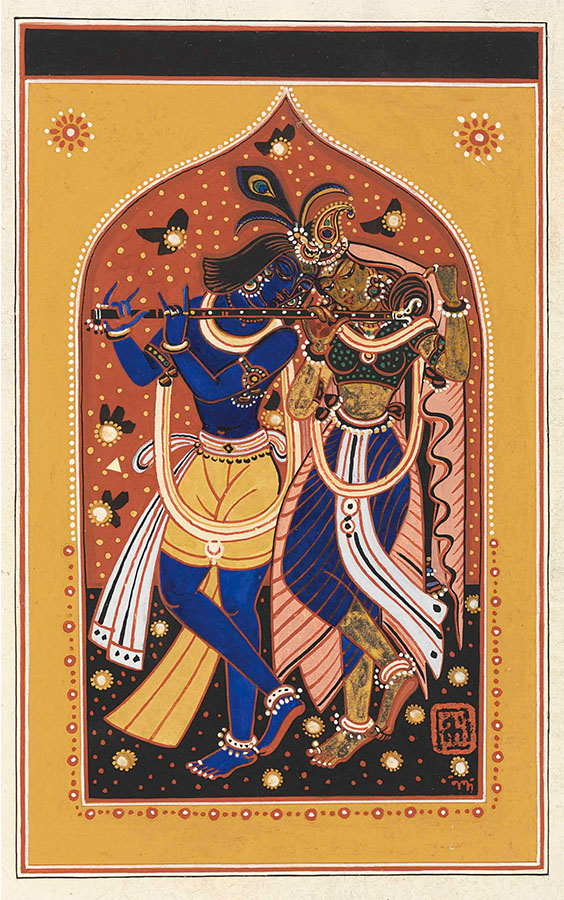
Nandalal Bose, Untitled (Radha Learning to Play the Flute), Tempera on handmade paper
This artistic philosophy is explained in the writings of Abanindranath Tagore, whose reflections on form shaped the thinking of the Bengal School painters. Drawing on older Indian aesthetic ideas, he described the human body through comparisons with nature. Nandalal Bose’s Radha Learning to Play the Flute (1940) brings these ideas vividly to life. In the shape of the faces, the curve of the brows, the long expressive eyes, and the graceful bend of the figures, we can see the visual language the Bengal School revived from earlier Indian traditions.
The Face

Nandalal Bose, Untitled (Preparatory Drawing for Radha Learning to Play the Flute), 1949, Graphite and India ink on newsprint,
Picture Credits: Christies and another version at Pundole's
Seen closely, the faces of Radha and Krishna follow the form described by Abanindranath Tagore in Some Notes on Indian Artistic Anatomy. In discussing the structure of the human face in Indian art, Tagore notes that the face is often described as “rounded like a hen’s egg.” This comparison appears in traditional descriptions of the human form and suggests a gently oval contour that narrows gradually toward the chin.
In Nandalal Bose’s painting, both Radha and Krishna display this softly tapering structure. The outline of the face curves smoothly along the cheek and descends toward a narrower chin which Tagore compares to the shape of a mango stone.
Eyes

Diagram of stylised eye forms described by Abanindranath Tagore.
Picture Credits: Some Notes on Indian Artistic Anatomy by Abanindranath Tagore
The eyes occupy a central place in Abanindranath Tagore’s discussion of artistic form in Some Notes on Indian Artistic Anatomy. He notes that Indian artists often described the eyes through comparisons with natural forms. Among the most common are fish-shaped eyes, whose elongated contour extends outward across the face. Other comparisons include the eyes of the deer, the lotus leaf, and the water-lily, each suggesting a particular quality of expression.
Tagore also refers to another type known in Bengal as patol-chera, resembling a sliced vegetable. This form, he notes, appears in the female figures painted on the walls of the Ajanta caves.
In Radha Learning to Play the Flute, the eyes of Radha and Krishna extend horizontally in elongated forms with gently tapering ends, recalling the fish-shaped and lotus-shaped eyes typical of the Bengal School, especially artists like Sunayani Devi.
Tagore describes the eyebrows as having the form “like the leaves of a neem tree or like a bow.” In the painting, the brows of Radha appear as thin sweeping lines rising gently above the eyes. Krishna’s brows follow a similar curved contour, framing the elongated eyes beneath them.
Nose
Abanindranath Tagore also describes the form of the nose in traditional Indian artistic anatomy. The nose, he writes, may resemble the sesame flower, while the nostrils are compared to the seed of barbati, or the long bean. In this form, the nose extends downward in a single continuous line from the space between the eyebrows, while the nostrils appear slightly rounded and convex, like the petal of a flower. This type of nose is commonly associated with female figures and appears frequently in representations of goddesses and women in Indian painting.
Another type described by Tagore is the parrot-nose, which is associated with male figures. In this form the nose rises more sharply from between the eyebrows and extends outward in a sweeping curve toward a pointed tip.
In Radha Learning to Play the Flute, the nose of Radha follows the more delicate linear form described for female figures. While Krishna’s nose appears slightly more pronounced, recalling the stronger contour described for male figures.
Lips
Abanindranath Tagore compares the lips to the bimba fruit (Momordica coccinia), whose smooth, rounded form provides a traditional model for their shape. Such comparisons appear frequently in descriptions of beauty in Indian artistic writing.
In Bose’s painting, Radha’s lips appear small and softly curved, recalling the rounded form associated with the bimba fruit. Beneath them, the face narrows gently before resolving in a soft curve at the chin, completing the oval contour of the face.
Limbs
Tagore extends these comparisons to the limbs of the body. Poets, he notes, have sometimes likened the hands to snakes or creepers, images meant to evoke their pliant, clasping character. Yet he observes that the elephant’s trunk offers a more complete comparison, suggesting both the form of the hand and its characteristic movements. The forearms, from elbow to palm, are described as resembling the trunk of a young plantain tree, while the fingers may be compared to beans or pea-pods.
In Radha Learning to Play the Flute, these forms appear in the slender tapering of the arms and hands. Radha’s fingers close gently around the flute in a delicate clasp, while Krishna’s hands hold the instrument from either side. Their forearms incline toward one another, and both figures stand with their legs crossing slightly inward. Tagore notes that the thighs, in both male and female figures, have long been compared to the trunk of the plantain tree, whose upright form supports the body. The hands and feet, he adds, are traditionally associated with the shapes of the lotus or young leaves of plants, a resemblance he observes particularly in the painted figures of Ajanta.
If Abanindranath Tagore’s text helps us recognise the stylised forms of the face, eyes, hands, and limbs, it is Nandalal Bose’s own sensibility that gathers them into a living image. One writer remarked that sketches were to Nandalal what songs were to Rabindranath Tagore—a comparison that feels especially apt here. The painting is held together by line: in the curve of the brows, the long shape of the eyes, the clasp of the fingers around the flute, and the slight inward bend of the two figures.
Bose’s palette is characteristically mild, often built from whites, dark tones, and the brownish tint that appears frequently in his work. Such colours create a subdued atmosphere in which line remains the primary vehicle of expression. In Radha Learning to Play the Flute, the ideals associated with the Bengal School—drawn from older Indian traditions and shaped through stylised form—appear with unusual clarity. The painting shows how those conventions could remain exacting and at the same time deeply lyrical in Bose’s hands.
References
[1] Abanindranath Tagore Some Notes on Indian Artistic Anatomy
[2] An Album Of Nandalal Bose With A Biographical Note Art Calcutta 1956 Santiniketan Asramik Sangha
[3] Das Ramyansu Sekhar, Nandalal Bose and Indian Painting, 1958

