During the mid‑1970s, Lalitha Lajmi created a set of abstract drawings using pen, brush, and pencil. At a glance, these drawings look like landscapes: leaves, stones, mountains, and flowing water. When looked at closely, faces, masks, and a fallen bird appear. She made these drawings unconsciously, during a period of upheaval. At that time, she was starting psychoanalysis. Felt uneasy about the difference between her abstract work and her oil paintings. For years, these drawings stayed in a drawer, and after this series, she never returned to abstraction.
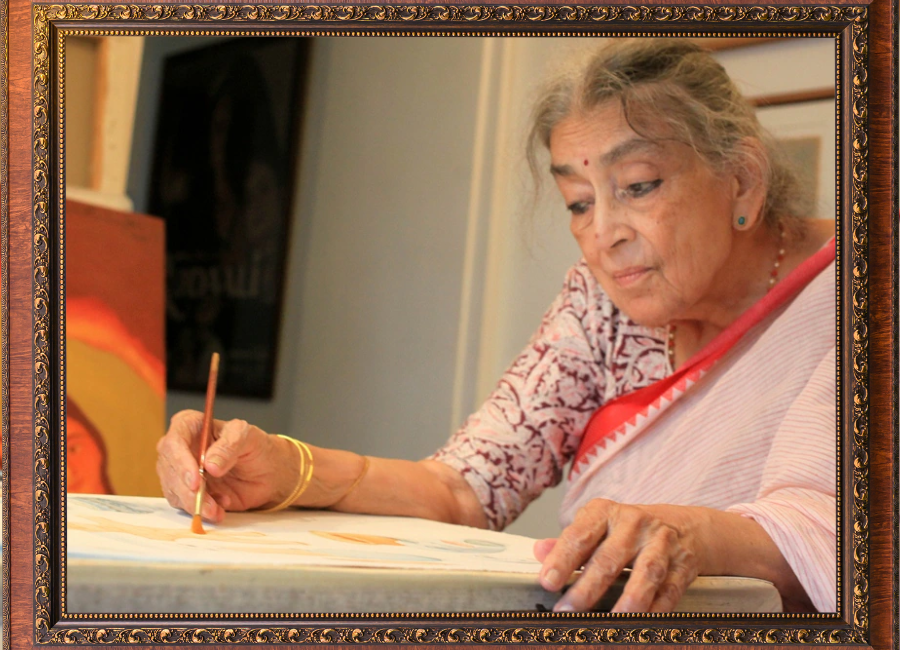
In this conversation, Lalitha Lajmi flips through the pages with Harsharan Bakshi. She discusses how the work came to be: the Japanese card paper and fine nib she chose, why she believes viewers should find their own meaning, and what Lalitha Lajmi thinks about abstraction itself.
Lalitha Lajmi: What exactly you want to know about it?
Harsharan Bakshi: I just got ideas. When did you exactly start doing abstracts?
Lalitha Lajmi: Uh, '73, '73, '74, '75. Two, three years. And then I entered in psychoanalysis—
Harsharan Bakshi: Mm-hmm.
Lalitha Lajmi: —and took sessions because I was doing this kind of work, and in oils. At that time, I used to do a lot of oils.
Harsharan Bakshi: Mm-hmm.
Lalitha Lajmi: I... watercolors started much later.
Interviewer: Okay.
Lalitha Lajmi: So oils, when I was doing, it was totally different.
Harsharan Bakshi: Mm-hmm.
Lalitha Lajmi: So, uh, I was having this in my mind: why am I doing two different kinds of work? That disturbance made me go for psychoanalysis. And I took sessions there.
Harsharan Bakshi: Mm-hmm.
Lalitha Lajmi: And also, uh, it was some problems in my domestic home problems, disturbance with them. And I also lost my brother Guru Dutt, but not at that time, it was a little later. He passed away in '62, I think, yeah, '62*. But this is—
Harsharan Bakshi: '70*.
Lalitha Lajmi: Somewhere '70*, yeah. But it was still... the disturbance was there. And I started unconsciously these works.
Harsharan Bakshi: Mm-hmm.
Lalitha Lajmi: Now, I don't know what, how to explain, but I use landscapes, and you can see.
Harsharan Bakshi: Right.
Lalitha Lajmi: And, uh, leaves, see, you can make out.
Harsharan Bakshi: Mm-hmm.
Lalitha Lajmi: I think, I feel whatever work I've done, the viewer should understand. You need to certainly explain... I don't know, I mean, just now when you're asking. But shortly, it looked like because I, you know, I think that those who see my work, they should—
Harsharan Bakshi: Interpret.
Lalitha Lajmi: —they should have their own interpretation. You know, this looks like a mask. They don't... it's, no one can get it.
Harsharan Bakshi: Right. Yeah.
Lalitha Lajmi: Also, I was not sure what I was doing. You know, these are works from my subconscious. When I was doing painting, I never thought what image should come. Afterwards, this also, these leaves. Here also, it's like an abstract piece. And, you know—
Harsharan Bakshi: Right.
Lalitha Lajmi: Why I have done, I don't know. I'll explain. This work is vertical.
Harsharan Bakshi: Mm-hmm.
Lalitha Lajmi: Those are verticals. Now, this work, you can make out?
Harsharan Bakshi: Leaves.
Lalitha Lajmi: Leaves, yeah. And there's a lot of trees, look at the tree.
Harsharan Bakshi: Yeah.
Lalitha Lajmi: So it's nature, you know. Nature, at the same time, on the whole, when you see, it's a mask. The face, the black part. Stones. It's like upside down. No, but here the trees, obviously, you can make out the tree. But there are some drawings where you can't make out what it is. Would you wait? These... I would like to have one set. It is there in that book?
Harsharan Bakshi: No, not here.
Lalitha Lajmi: No, because I have... I mean, you can't have copies of this because this is not print.
Harsharan Bakshi: Right.
Lalitha Lajmi: So this single copy.
Harsharan Bakshi: Yes.
Lalitha Lajmi: See here. Ah, see this way. If you see one tree and you thought... see, oh, sorry, horizontally. See here.
Harsharan Bakshi: Mm-hmm.
Lalitha Lajmi: Stones, tree, tree, tight lines here, you know.
Harsharan Bakshi: Mm-hmm.
Lalitha Lajmi: Also, very minute work. Leaves are there. Why the lines? Stones. Some places you see water.
Harsharan Bakshi: Yeah.
Lalitha Lajmi: This is a set of... if you can give me.
Harsharan Bakshi: Uh, okay.
Lalitha Lajmi: Just to keep in my, for my—
Harsharan Bakshi: Yeah, I'll ask.
Lalitha Lajmi: This is like underwater.
Harsharan Bakshi: Okay.
Lalitha Lajmi: Sorry. This way or that way. (laughs) In abstract, you're not certain. You don't know which way the work is done. (laughs) This is like an underwater.
Harsharan Bakshi: Mm-hmm.
Lalitha Lajmi: Flow of water. Stones and this tree, This is horizontal.
Harsharan Bakshi: Mm-hmm.
Lalitha Lajmi: It's like a mountain tree. Stones. Stones. These stones. It is like a landscape. See, these are stones.
Harsharan Bakshi: Right, There's one fallen bird also, right?
Lalitha Lajmi: Which one?
Harsharan Bakshi: Not here, some other book.
Lalitha Lajmi: Oh, that. Not that.
Harsharan Bakshi: I think it's come.
Lalitha Lajmi: Another one. Um, yes, that fallen bird, that's a dead bird. So I was... I might have seen it somewhere in my conscience or I have actually seen.
Harsharan Bakshi: Your dreams.
Lalitha Lajmi: Because, you know, you must have seen birds like crows—when they are gone, the other birds come and peck them. They do not like any human beings to touch. That's one thing I noticed with birds. They don't like to be touched. And also when they die, you know. So that is the image I showed you. This is... sorry. The moment you see... yeah. These are the images.
Harsharan Bakshi: Hmm.
Lalitha Lajmi: This also, Omnipool itself, mask.
Harsharan Bakshi: Right.
Lalitha Lajmi: Like, it's not history. It is this, you see? This is like a knot. [clears throat] Unfinished here. Wherever you see trees in a certain way, then you can make out whether you're horizontal or vertical. [clears throat] How much time it took, I don't remember now. To do each one.
Harsharan Bakshi: This one seems like a mask.
Lalitha Lajmi: Hmm. This is like a mask. You can see, huh? But Indrajit is so fast in seeing. (laughs) Amazing that these... you know, these, I have not shown it to anybody. And they were in a drawer, my... for many years. And I had decided not to show it to anyone. NGMA show. And here, this is destiny. He came here, he just said, 'I want this.'
Harsharan Bakshi: (laughs)
Lalitha Lajmi: Is it two different works or...
Harsharan Bakshi: These are two different works.
Lalitha Lajmi: Looks like two different works. Because the height line. This is horizontal. And this is vertical. Sorry, this is vertical, and this is horizontal. Yeah. Yeah. I'm just explaining with your mind, not somebody else's. You have any copies of this? No.
Harsharan Bakshi: No. We can make one.
Lalitha Lajmi: We can make, huh? The same size. Because when you make it too small, then you can't read the details.
Harsharan Bakshi: These are copies, Indrajit. The ones you can keep with you.
Lalitha Lajmi: Photograph.
Harsharan Bakshi: Yeah, yeah. These are just photocopies of the artwork.
Lalitha Lajmi: Haan, haan, yeh. But dekh, dekh, isse na zara kuch aisa hoga. Yeh hamara hi kaam hai Jagat. Woh khareeda bola na, yeh. Iska aur copy nahi ho sakta hai na ab. Humne, hamare liye, toh aise yahi size ka humko banate denge. Photo ya photo bolte hain. ("Yes, yes, this one. But look, look, with this, it will turn out something like this. This is our own work, Jagat. He said he had bought it, this one. There can't be another copy of this now, can there? For ourselves, they will let us have them made in exactly this size. A photo, or whatever they call it, a photo.") How is it done?
Harsharan Bakshi: Rahul will do it. (laughs)
Lalitha Lajmi: Even I don't know that. (laughs) Shall we see? Abstract trees, abstract mountains. Mostly it is nature picture.
Harsharan Bakshi: Yeah.
Lalitha Lajmi: But at the same time, there are forms, different forms. See this, different kind of work that he do. This pencil I used. But, you know, black and white always is very interesting. But, uh, he must be a very unique collector, art collector, Indrajit. Otherwise, people want only color.
Harsharan Bakshi: Right.
Lalitha Lajmi: They don't want black and white. (laughs) All the time, even in my book. Wait, let me see. Like this. The paper is... But actually, I used Japanese card paper at that time.
Harsharan Bakshi: Okay.
Lalitha Lajmi: Because the pen would, uh, with the fine nib, even today, you need smooth paper. Not these drawing books, drawing sheets, and file. They have that tissue grainy thing. And for pen work, it is not good. You need a smooth paper. So it was at that time Japanese card paper. It was plain white. Later on, as it aged, it becomes yellowish, Oh, this also two, two.
Harsharan Bakshi: Yeah.
Lalitha Lajmi: See, see this. You can make out? This tree and mountain. Some forms here. I've not repeated any of the forms. That's why they are here. Here also, mountain and... cannot explain. Uh, this is underwater.
Harsharan Bakshi: Yeah, this I think we discussed.
Lalitha Lajmi: You can make out, no? Underwater. I've used a little bit of pen also. Pen, I mean, not pen, brushwork. Brushwork. This is all brushwork.
Harsharan Bakshi: Okay.
Lalitha Lajmi: And this is a fine nib.
Harsharan Bakshi: Mm-hmm.
Lalitha Lajmi: I must have taken a long time to get this.
Harsharan Bakshi: Mm-hmm.
Lalitha Lajmi: This also.
Harsharan Bakshi: Leaves.
Lalitha Lajmi: See, you can see all leaves here. This, all shapes and everything. The thing is, with the fine nib pen, you can do very fine work. And also, it takes time to do these forms like that, and then to show black and white. The thing... I mean, my self-learning was that when you use one form, there should be another form that is darker or lighter according to the top form, you know?
Harsharan Bakshi: Okay.
Lalitha Lajmi: Now, this one.
Harsharan Bakshi: This one.
Lalitha Lajmi: Yeah, yeah. It's a good one. You can see the bird, the dead bird, you know?
Harsharan Bakshi: Yeah.
Lalitha Lajmi: It's not a tree. It is some ice, you know, some liquid form it comes from. I might have seen it. I might have seen a bird.
Harsharan Bakshi: So when did you start psychoanalysis? After this, after abstract?
Lalitha Lajmi: Uh, I can look. '74, '70... I think '76. '76.
Harsharan Bakshi: Mm-hmm. Soon after this?
Lalitha Lajmi: Soon after this. And also, I had two shows of oil paintings on abstract works. There was one, you know, they were next to Jahangir Art Gallery on the stairs. Behind Jahangir, there used to be German... the place where they have German classes upstairs.
Harsharan Bakshi: Okay.
Lalitha Lajmi: And downstairs, they used to have a big hall-like place. And they used to give it out on rent, or they used to, you know, sometimes we used to have our shows with their consent. So I had shown, I think... no, I had not shown these, but I had shown my oils of that time. Those years which I did. So that's where they turned. I feel sad that one book out of this is gone because... again, how many books? Even lately, I have given books of oils also as gifts, not realizing that they will have value.
Harsharan Bakshi: Value.
Lalitha Lajmi: Yeah. Many stories in this painting. Now, this is a mountain, see? And this is like a [clears throat] side view, profile of the trees. I mean, it looks like to me, I think. Here, see? You can... it can be this way, faces.
Harsharan Bakshi: Yeah.
Lalitha Lajmi: Pencil, I think... it's not pencil. I don't know this thing. (laughs) What I wanted to finish was, Hebbar did not like my work. And after that, when Hebbar had passed away, his daughter called me and she said, 'Please come for tea.' And I did go. Out of respect—he was a great artist.
Harsharan Bakshi: Right.
Lalitha Lajmi: And then after that, she has become one of my best friends. (laughs) She always said, 'Your father didn't like me, but you are...' Today she's in Bangalore, and she rings me up and talks to me, very, very nicely. Rekha, Rekha Hebbar, I think this is here. Yeah. Lots of abstraction. You know, when you do abstraction, it is for the artist. I mean, you don't... I don't know myself why I've done these also. Unconsciously, you know? Here, here I think it is vertical. Yes, it is vertical. See? Leaves. You can see.
Harsharan Bakshi: Mm-hmm.
Lalitha Lajmi: Uh-huh. There is one tree.
Harsharan Bakshi: One tree.
Lalitha Lajmi: And some stones. These are also leaves. All these are leaves, different kinds of leaves. You can call them leaves or you can call them flowers, but I don't know. Subconscious—I don't know whether there are plants or leaves like that. This is also a wood drawing.
Harsharan Bakshi: So it's like here.
Lalitha Lajmi: This way or that way? Let me see. Ah, this way. Horizontal. See here? Just down here. That's interesting. Small little pieces and beads.
Harsharan Bakshi: It's like a mushroom.
Lalitha Lajmi: But I want to tell you after what I had that picture in my mind. And after this exhibitions I had in the German Consulate, after that, I never went back to abstract. So these are precious. I've not done any more.
Harsharan Bakshi: Mm-hmm.
Lalitha Lajmi: You can take. It is personal, one's mind, you know, why one chooses to... artists, I'm talking. I don't mean ordinary people. Artists who choose the subject. But subject, if you see from the JJ School part... all the JJ students who pass out from JJ, they do abstract not knowing what it is. Why you're doing it—now, that question should come to your mind, you know.
Harsharan Bakshi: Mm-hmm.
Lalitha Lajmi: There they are trained for five years and religiously everything. It is not just figurative work, you see. They learn from Roman figures, drawings, then from life. They have nudes, they have clothed figures. They do such intense kind of study for four years. They come out doing abstract. Okay, you want to do abstract, so keep. But then explain why you are doing it! Explain why you're using the brush or a certain color. They try to cover and not really... And what is that? In one show, you must have some kind of image. You can't show, in one show, one landscape, one figurative, one abstract, all kinds of work. That is all right when you're a student, but to show in an exhibition is not done. Also, it doesn't show well of the artist why... Here, here, here, the tree. Is that the same one? No.
Harsharan Bakshi: I think this is one of the only ones that are in the book.
Lalitha Lajmi: I think it was the same poppy. One was—
Harsharan Bakshi: I think it is—
Lalitha Lajmi: Here, tree. It's a vertical one, see?
*Guru Dutt, Lalitha Lajmi's elder brother and the famous actor, director, and producer, passed away in 1964.

