Among the lesser-known archival treasures preserved in the estate of Rathindranath Tagore are several rare speeches of Kabiguru Rabindranath Tagore, some of which are believed to have been written and corrected by Tagore himself. These speeches are important not only as historical documents, but it also carries the voice of an ageing poet-philosopher reflecting upon art, education, spiritual crisis of the modern civilization, and the changing social atmosphere of Bengal and Santiniketan during the final years of his life.
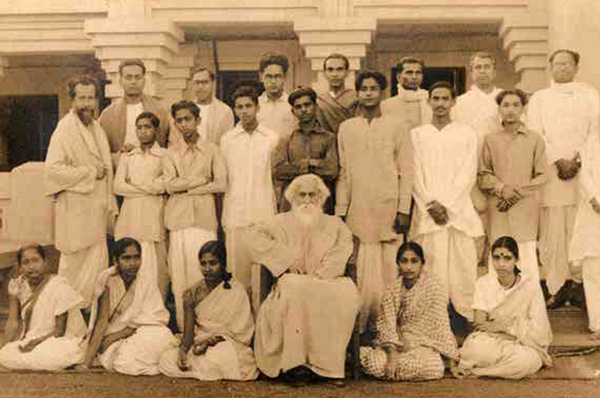 Rabindranath Tagore with Teachers in Santiniketan
The speech delivered on 11 December 1938 at Havell hall was dedicated to Ernest Binfield Havell, whose contributions to the revival of Indian art remain undeniable. In this speech, Rabindranath Tagore regarded Havell as one of the key figures behind the restoration of Indian artistic consciousness.
… to Havel Saheb I also express my gratitude. Even he had to endure a lot of torment. From the non-narrative that the Indian artists would get inspired by the developed ideals of ancient Indian art, was not tolerated by the countrymen that day. Everyone felt sad and annoyed. Even in that moment of disregard, getting inspired by this leader the great faith with which Aban could return to own native path can not be imagined today. Remembering this, today the leader has to be paid sincere regards. (Havell Hall Speech)
Tagore, in this speech, described how colonial education had distanced Indians from their own artistic roots and created blind admiration for European standards. He particularly emphasized Havell’s role in guiding Abanindranath Tagore towards the rediscovery of indigenous artistic ideals and spiritual foundation of Indian painting. The speech becomes not only a tribute to Havell but also a reflection of the cultural awakening of modern India.
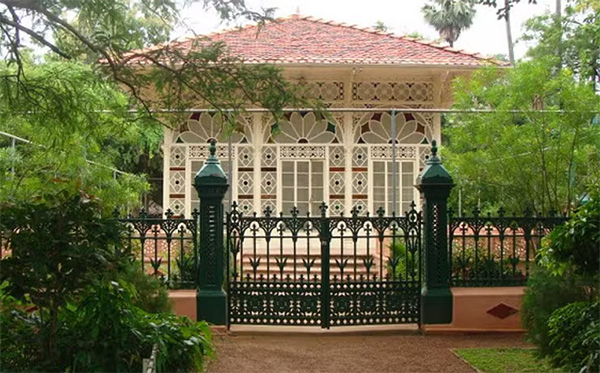 Santiniketan Mandir
In the Mandir speech, delivered at Santiniketan on 8 Shravan 1347 (24 July 1940) , Rabindranath Tagore reflected the early days of Santiniketan with emotion and nostalgia. He remembered how he had founded the Ashram with only a few students and teachers, inspired by a spiritual calling rather than worldly ambitions.
Many a day, I would gather with only one or two pupil ‘upasakas’ in front of the shrine (mandir). Uninterrupted attempts were aimed at awakening the dormant life-force. (Mandir Speech)
Here he also expressed his grief regarding the matter that modern scepticism and irreverence had weakened the spiritual atmosphere of the Ashram.
The archive of Rathindranath Tagore estate further contains an undated partial speech that carries a more critical tone. It reveals Tagore’s anxiety regarding the youth and political culture of Bengal. He criticised the tendency to glorify disruption over constructive responsibility, growing arrogance and indiscipline.
In today’s youth of Bengal, a sense of arrogance can be noticed. No law or order…(Partial Speech)
He spoke against the glorification of a society which neglects character and responsibility as he believes it is gradually weakening our own future.
Though spoken on different occasions, these speeches clearly revealed Rabindranath Tagore’s concern for the preservation of art, education and moral values even in his final years. Every single line of these speeches allow us to encounter a voice that remains profoundly relevant even today and teaches us that education without humanity, freedom without discipline and progress without moral depth can never sustain a civilization.
Havell Hall Speech: Colonial Impact on Art: Imitation, Rasa, and Rejection of Foreign | Prinseps
Santiniketan Mandir Speech: Rabindranath Tagore’s Vision of Ashrama and Mandir at Santiniketan | Prinseps
Partial Speech: Rebellion, Russian Novels, and Cultural Decay The Decline of Sanskrit and Tradition in Bengal | Prinseps

