In the mid-1950s, Jamini Roy was working from his studio in Ballygunge, South Calcutta, within walking distance of his home. He showed little inclination to travel. Contemporary accounts note that he rarely left the city and routinely declined invitations to exhibitions and public appearances that would have taken him elsewhere. Yet one of his paintings hung thousands of miles away, on the dining-room wall of a house in Coogee, a coastal suburb of Sydney.
The house belonged to Oscar Edwards, an Australian artist and collector. As later documented in Art and Australia (September 1969), Edwards lived among objects gathered through correspondence and exchange: Aboriginal bark paintings from Arnhem Land, pre-Columbian ceramics, Chinese figures, Egyptian fragments, and European modern works.
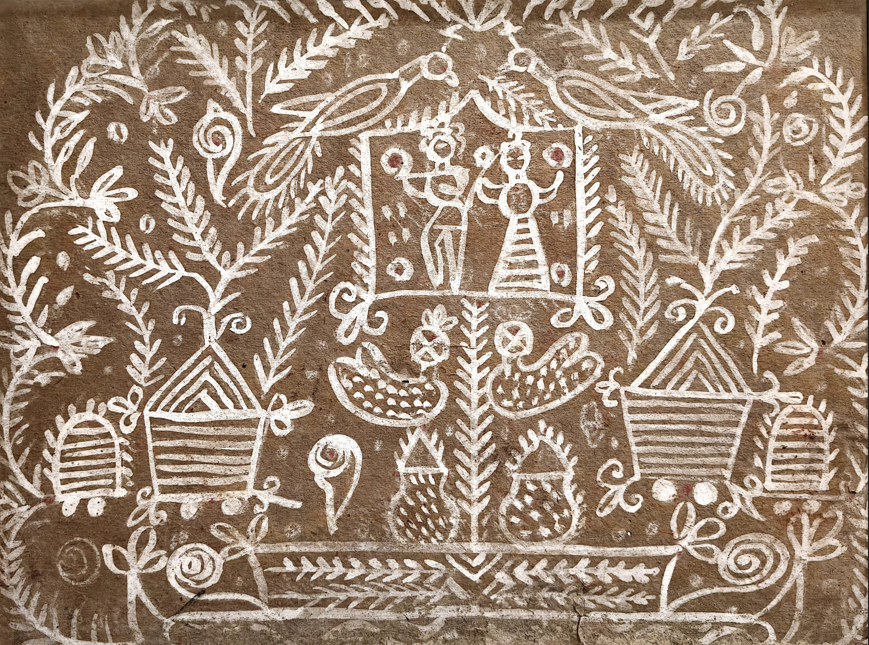
Jamini Roy, Untitled (bark-like painting), c. mid-1950s.
Within Roy’s known body of work exists an atypical painting, distinguished by its bark-like surface and linear handling. While its imagery remains consistent with Roy’s pictorial language, the material treatment differs from the formats that recur elsewhere in his practice. Read alongside Edwards’ correspondence, the work can be situated within a specific and limited context: a moment when Roy’s paintings travelled outward, and images of other visual traditions reached him by post.
.jpg)
Letter from Oscar Edwards to Jamini Roy, dated 5 December 1955, Coogee, New South Wales.
The connection between Jamini Roy and Oscar Edwards is recorded in a letter dated 5 December 1955, written from “Kew Cottage,” 330 Alison Road, Coogee, New South Wales. Addressed simply to Roy, Edwards writes as one working artist to another, without the mediation of a gallery, institution, or dealer.
Edwards acknowledges Roy’s earlier note and responds at length. He writes about age and illness, about artists he had encountered in Europe—including Pablo Picasso and Henri Matisse—and about painters working in Arnhem Land whose work he regarded with seriousness and respect. He is explicit in rejecting the term “modern,” which he considered inadequate for describing creative practice across cultures and time. “I do not like to call it modern,” he writes, adding, “I believe that creative art of all ages has the same fundamental quality.”
The letter is materially specific. Edwards notes that he is enclosing photographs of his own work, along with snapshots of Aboriginal bark paintings from Arnhem Land and other items he thought Roy might find of interest. He also mentions a cutting from Art News and Review (London), asking Roy to return it once read.
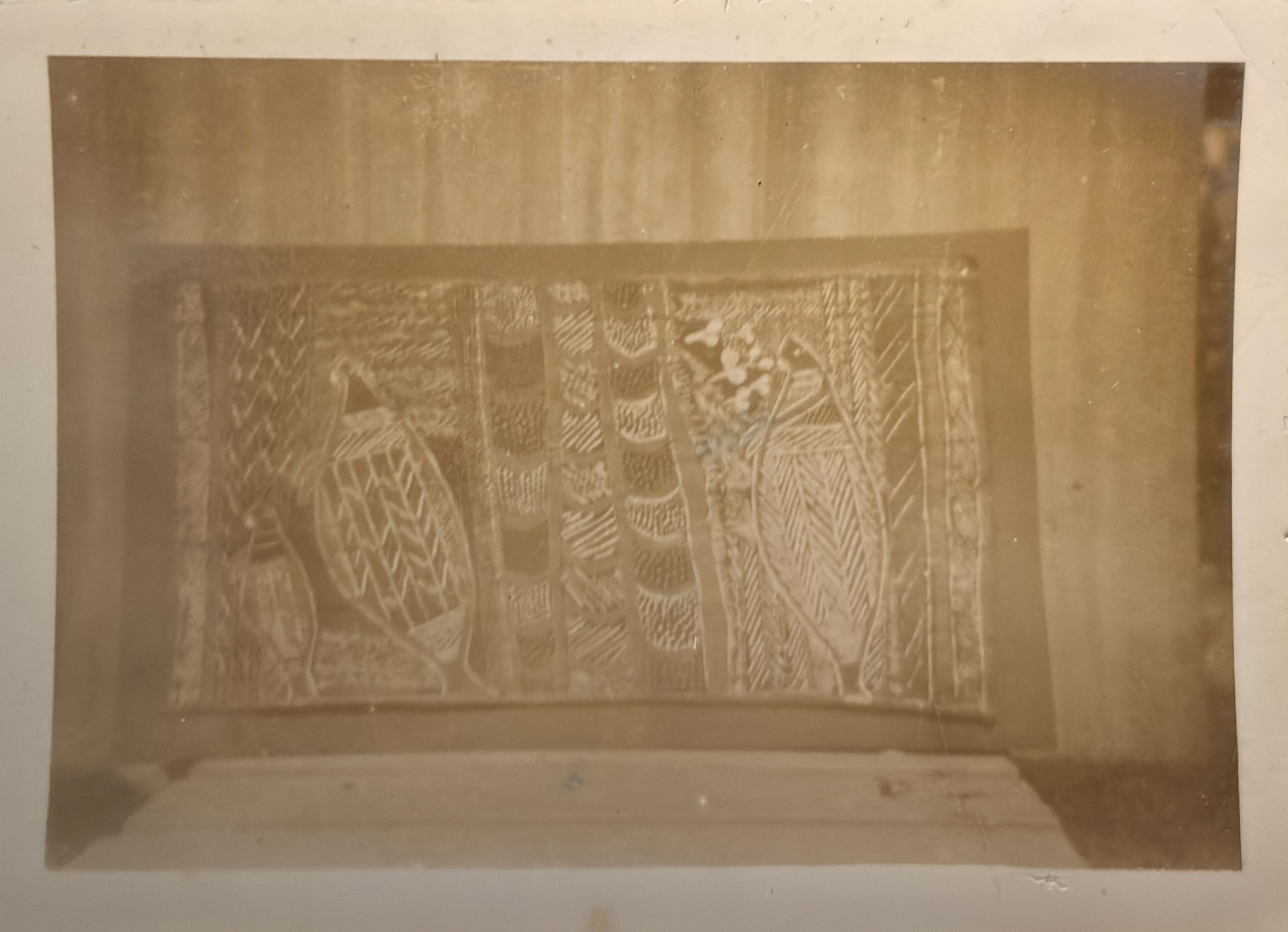
Aboriginal Bark Painting sent to Jamini Roy by Oscar Edwards
Alongside these photographs, Edwards enclosed a small, hand-painted New Year greeting card. He is careful to clarify its intent: it was sent “not as a work of art by any means,” but as a gesture of goodwill.
.jpg)
Hand-painted New Year greeting card sent by Oscar Edwards to Jamini Roy, 1955.
What survives of the exchange between Jamini Roy and Oscar Edwards is neither a formal collaboration nor a documented influence, but a small, coherent archive of correspondence and objects. The letter of December 1955, the photographs of Aboriginal bark paintings, the hand-painted greeting card, and the atypical bark-like painting together register a moment when images, materials, and ideas circulated outside institutional frameworks.
For Roy—who largely remained within Calcutta—such exchanges allowed distant visual traditions to enter the studio through the post. For Edwards, collecting and correspondence were extensions of artistic practice itself. Read together, these materials offer a precise historical instance of mid-twentieth-century artistic exchange.

