1948 - The First AVATARS' - Discussing The Profile Picture Project
This endeavor strives to be a landmark Profile Picture project strongly rooted in modernism. This is not a doodle project. Each artwork is legitimate modern art.
Read More
This endeavor strives to be a landmark Profile Picture project strongly rooted in modernism. This is not a doodle project. Each artwork is legitimate modern art.
Read More
First and foremost, each artwork is new and unique having been generated by a mix of layers extracted from the original portraits created in the 1940s. We are enthused to retain the immense colour palette of the artist and the detailed texturing in his drawings. This detailed texturing is also what hugely differentiates this project from the simplistic doodle-based profile picture projects. The project is in collaboration with the Artists' Estate, which includes the due transfer of Copyright for these works to the project (this is huge!). We start from a set of around 50 'Avatars' - which are art works that the artist created in the years 1948-1951.
Read More
Recognised by its distinctive catchy saxophone melody; imaginative, jolting drum solo; and use of the unusual quintuple (5/4) time signature, the jazz standard ‘Take Five’ by the Dave Brubeck Quartet was not the first jazz composition that used the quintuple meter but it was one of the first in the United States to achieve mainstream significance in 1961.
Read More
Modernism is crucial and important for collectible-grade art, and this principle extends to art in the digital format. This is what shapes our approach and sets us apart. Notably, this endeavor is poised to be India's first serious modern art profile-picture project .
Read More
What could possibly have been in the artist’s consciousness in 1948? Who are these characters? Read on to know more.
Read More
Here are some of the NFT-related topics we discussed at the Soho House, Mumbai on 11th June 2023. We discuss what is an NFT and the the various issues surrounding these. We also introduce Gobardhan Ash's avatars - artworks created between 1948 and 1951 which are similar to the profile picture projects created in the early 2020's. The focus of Gobardhan Ash's avatars was the personality trait, the emotional bonding, the role of the person, and not the detailed features of the person. The goal being to identify the trait by looking at the artwork. The video of the presentation is available here.
Read More
As we prepare for the exhibitions of Jamini Roy, Atul Bose, Gobardhan Ash, Bhanu Athaiya, and Rathin Maitra, we have realized that the context and continuum of the modernist movement around the early 20th century are somehow forgotten. We strive to bring them to light in hopes of more research and discussion. (Refer here) This write-up focuses on Calcutta and Bombay.
Read More
At Prinseps, we are working to change the discourse to redefine the critical period for modernism in India as the first half of the 20th century. Though academia reiterates the same, the art trade seems to have strayed with a focus on the later part of the 20th century. The early 20th century witnessed the uprising of major art movements questioning the status quo.
Read More
Inclined towards donning a baseball cap, adorning his rounded countenance with his distinctive dark goggles, along with his hallmark goatee and long curly locks, Louiz Banks, the legendary Indian jazz musician and composer is renowned as the "Godfather of Indian Jazz", for his immense contribution to the genre over the past five decades. Hailing from a family of six generations of musicians, Banks inherited his love for music from a young age and has myriad contributions to his name in the field of Indian music, unrestricted to jazz.
Read More
One of America's top exports to the rest of the globe is jazz. A musical form rooted in the blues, it is characterised by its spontaneity and improvisation. Jazz began to take shape early in the 20th century in the United States, with the Mississippi River's mouth neighbourhood of New Orleans being crucial to its growth. Since the city had the most ethnically diversified population in the South, it resulted in exchanges between people of English, African, French, Caribbean, Italian, German, Mexican, and American Indian descent.
Read More
I sit staring into the blank canvas. My mind is unfettered, reaching out to embrace the world. All these shapes and scenes flit lucidly through my head, some familiar, others, I know not. Speaking of Modern Art, I must emphasise the fact that the art being created these days, cannot simply be labeled as Indian Art.
Read More
Manjit Bawa is most often approached through his mythic protagonists—Krishna, animals, lovers—held in suspension against vast, luminous grounds. Yet the language that carries these narratives begins earlier, as form: rounded, pliant, weightless. The 1977 abstract canvas Untitled (Free Floating Form) under discussion foregrounds the unit before it becomes figuration. It is not an outlier, separated from Bawa’s later world; it is a concentrated glimpse of the grammar he would go on to expand.
Read More
The Principal of the Government Art School, Mr. Percy Brown was scheduled to retire in1928. There were still two years left until the retirement of the Vice Principal Mr. J.P. Ganguly ( Jamini Prakash Gangooly) and he was owed two years of leave. It was heard then that artist Mukul Dey would be appointed as the principal of the Government Art School soon. At that time, Mr.T.A. Achary was serving as the headmaster and Nandalal Roy Choudhury was the head clerk of Arts School and the superintendent of the contemporary Student’s Hostel which was situated on the Corporation Street and he used to live in that hostel.
Read More
Bhanu Athaiya won India its first Oscar in 1983 for the film Gandhi in the Best Costume Design category. As a child, Bhanu Athaiya was surrounded by the growing surge of Indian consciousness and the influence of Gandhi. People had taken to wearing khadi clothes and Gandhi caps. This first-hand influence of Gandhi in her life was something she could not have developed with any amount of reading or research. Richard Attenborough, a foreign film director, came to India to make a film on Gandhi after 17 years of visiting the country repeatedly. He appointed Bhanu as the film's costume designer.
Read More
Rathin Maitra and Subho Tagore established the Calcutta Group, along with other founder members, which gained widespread recognition in India for its influential contribution to modern Indian painting much before the Progressives.
Read More
Modern art is a continuum - so the above title is not appropriate but necessitated due to recent events. The artwork pictured here is crucially important and was extracted around 2017 from Jamini Roy’s residence in Ballygunge Place East. The work used to be so significant that it would be seen at the entrance of his studio and was used in every exhibition as a welcome continuing the Bengali tradition of Alpona.
Read More
Following the opening of The Legacy of Bhanu Athaiya exhibit was an insightful discussion between stalwarts Ritu Kumar (Textile Historian and Fashion Designer) and Kiran Nadar (Founder and Chairperson KNMA). H.H. MAHARANI Radhika Raje Gaekwad of Baroda inaugurated the event and fondly spoke of her learnings while documenting and intensively researching the legacy of India's most globally renowned costume designer Bhanu Rajopadhye Athaiya. Click here to watch the video.
Read More
The first Indian woman painter to gain public recognition Sunayani Devi (সুনয়নী দেবী) was born in Calcutta, to the Tagore family of ingenious writers and painters.Often considered among the first women painters in India, she grew up amidst the cultural ferment that was the Bengal Renaissance. She was brought up in the traditional and secluded women's quarters. She recalls her fascination with the devotional pictures in her aunt's room as a child. At that time, " it was unknown and unheard of for women to do anything."
Read More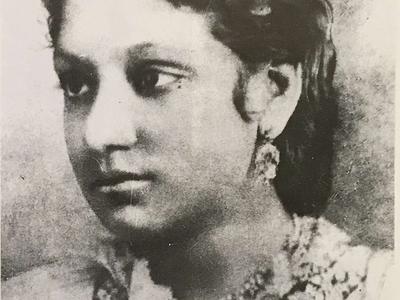
In celebration of Women's History Month, we are highlighting Indian women artists who have shaped the art world with their creative practice. We begin with Mangala Bayi Thampuratti, the first woman artist to have worked in her own studio in the nineteenth century and the only sister of the eminent painter Raja Ravi Varma. Despite societal restraints, Mangala Bayi made a name for herself in the history of Indian art.
Read More
The Hindi movies that I grew up watching in the ’70s, in theatres, and then in the ’50s and ’60s on Television, left lasting impressions. What attracted me most was the song & dance and the costumes worn by the stars. Many years later, I learned to my surprise that almost every look that was created for the actresses right from Waheeda ji, to Mumtaz ji to Zeenat ji – was by one person - Bhanu Athaiya!
Read More

Install this application on your home screen for quick and easy access
 then 'Add to Home Screen'